You match your passport’s validity to the destination’s rule, usually six months beyond your stay, then pick the visa type that fits your trip’s purpose—tourism, business, study, work, or family reunification. Fill the appropriate online form (like DS‑160 for U.S. non‑immigrants), upload a compliant photo, pay the fee, and schedule an interview if required. Gather supporting documents such as bank statements, itinerary, and proof of ties to your home country, then attend the interview and follow any post‑interview instructions; proceeding further will reveal more details.
TLDR
- Identify the destination country’s visa category (tourist, business, work, family) based on trip purpose and eligibility criteria.
- Verify passport validity (typically six months beyond entry) and obtain required photos before starting the application.
- Complete the appropriate online form (e.g., DS‑160 for U.S.) and pay the designated fee, then schedule the interview if required.
- Gather supporting documents such as bank statements, travel itinerary, proof of ties, and any sponsor letters to avoid rejection.
- Track application status through official portals (e.g., CEAC, embassy site) and plan for possible processing delays or administrative processing.
Step‑by‑Step Guide to Getting a US Visa
If you’re planning to travel to the United States, the first thing you need to do is make sure your passport is valid for at least six months beyond your intended entry date, unless your country has a specific agreement that waives this requirement. Verify passport validity, then fill out the DS‑160 completely, upload a compliant photo, and print the confirmation page.
Gather required documents, pay the fee, schedule your interview, attend it with fingerprints taken, and follow any post‑interview instructions. Form I‑130 must be filed with USCIS if you are a U.S. citizen or lawful permanent resident sponsoring a relative. If you’re also dealing with hotel plans that may end early, be aware that an early departure fee can apply when you cancel after the cancellation deadline or after check-in.
Select the Right Visa Category for Your Trip
Choosing the correct visa category starts with identifying the primary purpose of your trip, because each category aligns with specific activities and eligibility criteria.
If you travel for business, pick B‑1; for tourism or medical treatment, B‑2 fits.
Family reunification uses IR, CR, K, or follow‑to‑join visas.
Work‑related trips require E, O, or specific employment visas.
Transit, crew, diplomatic, or waiver options follow their own rules.
Match purpose to category for smooth entry.
For digital nomad plans in 2026, review the income thresholds that certain countries set to qualify for remote-work visas.
Check Typical US Visa Processing Times
Because visa processing speed varies widely by type and location, you’ll want to check the latest wait-time tables before you schedule your interview. Nonimmigrant visitor waits range from under half a month to over a year, depending on the embassy—San Jose can be six months, San Salvador less than half a month. Review the online scheduling system after submitting DS-160 and paying the fee to see current availability. If you’re traveling to enjoy mango sticky rice and other popular desserts, build extra buffer time in case your visa timeline shifts.
Locate Official US Visa Forms and Fees
You’ll first locate the DS‑160 form number and any other category‑specific forms on the official State Department site, then verify the current fee schedule for your visa type, and finally use the same site to access the payment and scheduling portals. Checking the fee tables on travel.state.gov makes sure you’re seeing the most up‑to‑date amounts, which can differ by country and visa class. Before you pay, also confirm the exact fee structure tied to visa type to prevent surprises.
Find Form Numbers
To locate the official U.S. visa forms and their associated fees, start by visiting the Department of State’s website and moving to the “Forms” section, where you’ll find the DS‑160, DS‑260, and other application PDFs listed with their current fee schedules.
You’ll see DS‑156E, DS‑158, DS‑2019, DS‑7002, and I‑20 numbers clearly labeled, plus links to FAQs and the CEAC portal for each form.
Check Current Fees
Checking the current fees starts with visiting the U.S. Department of State website, where you’ll find non‑petition nonimmigrant visas at $185, petition‑based at $205, and a $250 Visa Integrity Fee for FY 2026.
Immigrant fees range from $205 to $345, while Diversity Visa costs $1 plus $330 per applicant.
Premium processing rises to $2,965 for I‑129/I‑140 and $2,075 for I‑539.
Student SEVIS is $350, and other ancillary fees vary by country.
Access Official Websites
Starting with the main portal, travel.state.gov/content/travel/en/us-visas.html gives you direct access to all official U.S. visa information, including links to the DS‑160 form, fee schedules, and step‑by‑step instructions for each visa category.
You can also browse state.gov/visas for requirements, usa.gov/non-immigrant-visas for student and work visas, and ustraveldocs.com for country‑specific guidance, ensuring you locate the correct forms and fees quickly.
Gather Required Visa Documents
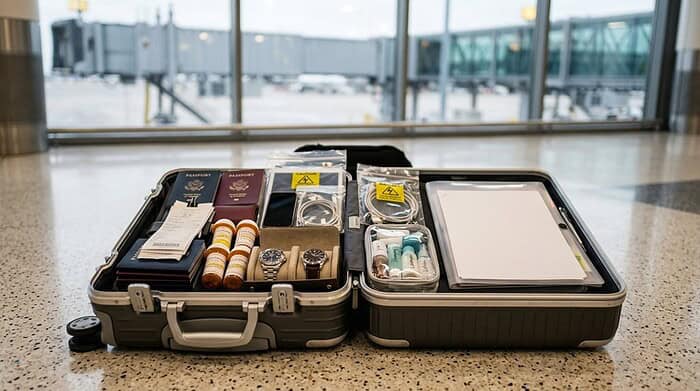
When you gather the required visa documents, start by confirming that your passport meets the specific criteria for the destination—typically it must be valid for at least six months beyond your planned stay, contain a minimum of two blank pages, and, for Schengen applications, have been issued no more than ten years ago. Print your DS‑160 or Schengen form, attach a compliant photo, include bank statements, proof of ties, travel itinerary, fee receipt, and any residency documents. Keep copies of biographical pages and make sure all items follow embassy guidelines. Also, organize your medications in clearly labeled containers, since TSA typically uses X-ray screening for solid prescription medications.
Schedule and Prepare for Your Visa Interview
You’ll need to gather all required documents—passport, DS‑260 confirmation, medical results, photos, and any supporting paperwork—before you can book your interview slot. When scheduling, log into the embassy portal as soon as you receive the NVC appointment notification, pick a date that gives you enough time to complete the medical exam and obtain any needed vaccinations, and double‑check local guidelines for any extra steps. Arriving prepared with printed copies, a sealed envelope of medical results, and a clear understanding of the interview timeline will help the process run smoothly. Make sure your information matches exactly across TSA 3-1-1 compliance paperwork and any forms you submit to avoid delays.
Required Documents
Gather your passport, DS‑160 confirmation, photographs, appointment letter, and supporting civil documents before the interview, because each item serves a specific verification purpose.
Bring a passport valid six months beyond entry, include old passports for history, and make certain every family member has an unexpired one.
Print the DS‑160 barcode page, two recent 2×2‑inch photos, and the appointment letter.
Pack originals or certified copies of financial statements, tax returns, employment proof, property records, and any national ID.
Interview Scheduling Tips
After gathering your passport, DS‑160 confirmation, photographs, appointment letter, and supporting civil documents, the next step is to lock in a visa interview date.
Use the embassy portal, pay the fee, and pick the earliest slot.
If you need an earlier time, request a change through the system, consider another consulate, or apply for emergency appointments with supporting documents.
Arrive early, bring printed confirmations, and be ready for fingerprints and a brief interview.
What to Do If Your Interview Is Delayed?
If your visa interview has been postponed, the first step is to confirm the new date and understand why the delay occurred; common causes include pandemic‑related backlogs, staffing shortages, and heightened security screenings.
Check the consulate’s website for updates, consider requesting an expedited slot if you have a time‑sensitive reason, and seek nearby posts with shorter waits.
Keep documents ready, monitor email alerts, and stay flexible to adjust travel plans.
Check Your Visa Status Online
When your interview is postponed, the next logical step is to verify whether your application has moved forward in the system.
Visit the CEAC portal at ceac.state.gov, enter your 13‑digit barcode, select the interview location, and provide your passport number if required.
You’ll see statuses like “Not Yet In System,” “Ready for Interview,” or “Administrative Processing.”
Alternative trackers include VFS Global, embassy sites, or USCIS for H1B petitions.
Common Visa Rejection Reasons & Prevention
You’ll often be turned down if your paperwork isn’t complete or if your finances don’t match the trip’s purpose, so double‑check every required document and make sure your bank statements show a stable, sufficient balance.
Even small inconsistencies—like mismatched dates or vague travel itineraries—can raise red flags, while clear evidence of strong ties to your home country and a realistic budget usually keep you in the clear.
Insufficient Documentation
Because consular officers scrutinize every piece of paperwork, missing or incomplete documentation is one of the most common reasons visas get rejected.
You must make certain every DS‑160 or DS‑260 field is filled, dates are correct, and supporting documents match your application.
Provide a valid passport, employment letters, school records, itinerary, and any required test scores.
Verify translations, avoid inconsistencies, and bring all requested papers to the interview.
Financial Ineligibility
Financial ineligibility tops the list of common visa rejections because consular officers must be convinced you can support yourself—or any dependents—without becoming a public charge.
Show steady bank balances, regular income, and realistic travel plans that match your means.
Provide complete sponsor documents, recent statements, and Form I‑134 if needed.
Avoid sudden large deposits, outdated records, and unrealistic itineraries to prevent red flags.
Extend, Change, or Upgrade Your Visa After Arrival
If you’re already in the United States and realize you need more time, a different purpose, or a higher‑level visa, you can request an extension, a status change, or an upgrade without leaving the country.
File Form I‑539 with your passport, I‑94, and proof of purpose; apply at least 45 days before expiration.
Keep lawful status, avoid crimes, and make sure passport validity throughout any extension or upgrade.
Fast‑Track Visa Options for Major Events
When you’ve already secured a visa or extended your stay, the next step is to learn how fast‑track options can expedite entry for major events.
You can use FIFA’s prioritized appointment system, which cuts scheduling to under 60 days for most applicants, and claim priority if you hold World Cup tickets.
Canada’s SELU grants special event codes to groups of ten delegates, enabling faster processing and status updates.
Private services like CIBTvisas add a rush fee for even quicker clearance, and premium travel cards enable airport fast‑track lanes in Europe.
And Finally
By following these steps, you’ll know exactly which U.S. visa fits your travel purpose, how long processing takes, and where to find the official forms and fees. You’ll also understand the documents you need, how to monitor your application online, and the common reasons visas get denied. If circumstances change, you can extend, modify, or upgrade your visa after arrival, and fast‑track options exist for major events. This clear, factual guide helps you work through the U.S. visa system efficiently.