First, check if EU261 covers your flight: it applies to any airline flying within the 27 EU states, any departure from the EU, and arrivals from outside the EU when an EU carrier operates. Keep your boarding pass, e‑ticket, booking confirmation, delay notices, and receipts for meals or lodging. Fill the claim form within 48 hours, using block capitals for personal details and flight info, then attach the documents and submit to the airline. Compensation ranges from €250 to €600 depending on distance and a three‑hour delay, unless the airline proves extraordinary circumstances. If you follow these steps, you’ll learn how to handle exemptions and even claim up to 400 % of your ticket cost.
TLDR
- Verify eligibility under EU261 by confirming the flight’s departure, arrival, and airline meet the regulation’s criteria.
- Preserve all evidence: boarding passes, e‑tickets, booking confirmations, delay notifications, and receipts for extra expenses.
- Submit a completed EU261 claim form within 48 hours, providing flight details, disruption type, and supporting documents.
- Claim the appropriate compensation amount based on flight distance and delay length (≤ 1,500 km €250, 1,500‑3,500 km €400, > 3,500 km €600).
- If the airline cites extraordinary circumstances, request proof of the cause and mitigation steps; without substantiation, you retain the right to compensation.
Step 1 – Is Your Flight Covered by EU261?

How can you tell if EU261 applies to your flight?
Check the route and carrier.
If you travel within the 27 EU nations, any airline counts.
Departures from the EU are covered, regardless of airline or destination.
Arrivals from outside the EU are covered only when an EU carrier operates the flight.
Non‑EU airlines arriving from non‑EU countries aren’t covered.
Make sure your reservation is confirmed, you checked in on time, and you hold a valid ticket.
This determines eligibility before you pursue a claim. Extraordinary circumstances must not be the cause of the disruption.
EU261 claims are typically evaluated against the airline’s responsibility for the disruption rather than purely on ancillary fees.
Step 2 – What Evidence to Collect for a Successful EU261 Claim
Now that you’ve confirmed the flight falls under EU261, the next step is gathering the proof that will back up your claim. Keep your boarding pass or e‑ticket, booking confirmation, and any delay notifications. Snap departure‑board photos, save airline emails, and request written staff statements. Collect receipts for meals, lodging, and transport, plus any bank records supporting expenses. TSA officer discretion can also affect what evidence is accepted if staff require specific documentation at checkpoints. All documents should be legible, digital or paper, and organized for easy submission.
Step 3 – How to Complete the Standard EU261 Claim Form in 48 Hours
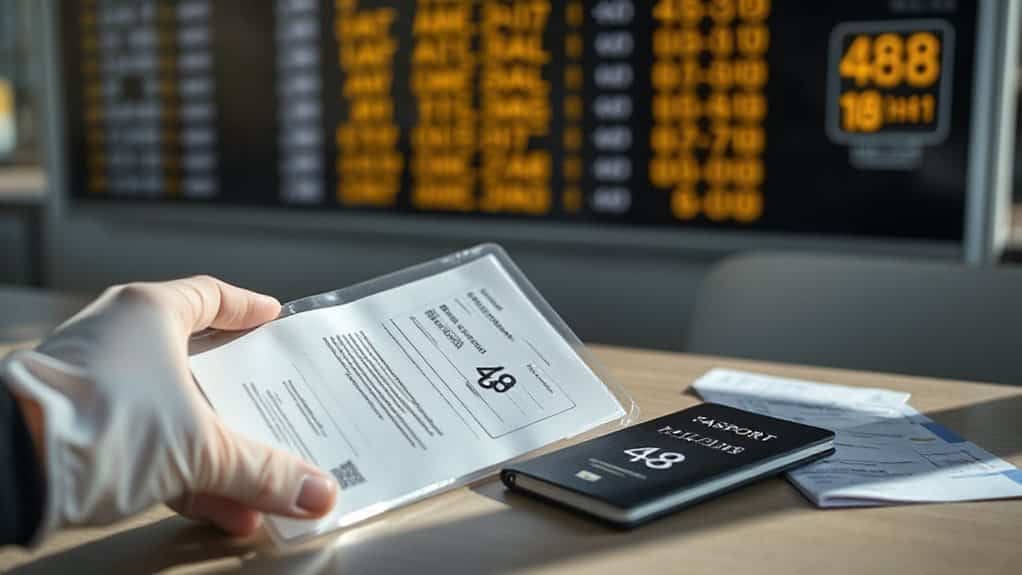
If you act quickly, you can finish the EU261 claim form within 48 hours and keep the process moving smoothly. Download the PDF, fill every field in block capitals, and enter your surname, address, email, and flight details—number, ticket code, original and actual times. Bluetooth in airplane mode can be used on flights when your airline permits it, so follow any cabin crew instructions. State the disruption type, sign, date, attach boarding pass and confirmation, then send the form to the operating airline via their website, email, or mail.
Step 4 – Compensation Amounts by Distance and Delay Length
You’ll see that compensation is split into three distance‑based tiers, each with its own delay threshold that determines whether you qualify for €250, €400 or €600.
Short‑haul flights need a three‑hour arrival delay, medium‑haul the same three‑hour window, while long‑haul flights require at least a four‑hour delay (some rules allow three hours).
Real-Time Pricing Dynamics also means airlines may adjust how they prioritize and manage inventory as situations change, which can influence how delays and disruptions are handled operationally.
Keep in mind that extraordinary circumstances—like severe weather or security threats—can exempt the airline from paying, even if the delay meets the standard criteria.
Distance‑Based Compensation Tiers
Determine the compensation you’re entitled to by matching the flight’s distance and the length of the delay.
For short‑haul trips (≤ 1,500 km), you receive €250 if the delay hits three hours. Medium‑haul flights (1,500‑3,500 km) earn €400 under the same three‑hour rule. Long‑haul voyages (> 3,500 km) qualify for €600 when delayed three hours or more.
Delay Thresholds by Flight Length
The compensation you receive depends on both the flight’s distance and how long the delay lasts, so after identifying the distance‑based tier, you now need to match it with the appropriate delay threshold.
For short‑haul (≤1,500 km), a delay of three hours triggers €250; medium‑haul (1,500‑3,500 km) needs three hours for €400; long‑haul (>3,500 km) requires three hours for €600.
If the airline diverts you, lower thresholds apply for re‑routing compensation.
Impact of Extraordinary Circumstances
When an airline can prove that a delay or cancellation was caused by extraordinary circumstances—events it couldn’t have anticipated or avoided under EU Regulation 261/2004—the standard compensation amounts based on distance and delay length no longer apply.
You’ll still get refunds, rebooking, and care, but no €600‑plus payout.
Airlines must show logbooks or incident reports linking the event— severe weather, ATC strikes, bird strikes, security alerts, or political unrest—to the disruption and prove it was unavoidable despite reasonable measures.
Step 5 – Dealing With Extraordinary‑Circumstances Exemptions
You’ll need to prove the airline actually took the required measures and keep a clear record of why the delay occurred. Ask the carrier for evidence of the external cause and any steps they took to mitigate it, and note every detail in your own documentation. If the airline can’t substantiate the exemption, you retain the right to claim compensation. Even when storms are involved, airlines should be able to demonstrate that they used Doppler weather radar and followed established avoidance procedures instead of relying solely on what was visibly apparent.
Prove Measures Taken
If an airline claims an extraordinary‑circumstance exemption, it must prove not only that the event was unforeseeable and beyond its control, but also that it took every reasonable measure to limit the impact on your flight.
You’ll need evidence of rapid actions—re‑routing, crew swaps, or ground‑staff alerts—showing they minimized disruption.
Documentation must demonstrate no feasible prevention existed, otherwise compensation remains due.
Document Delay Reasons
Airlines must back up any extraordinary‑circumstance claim with concrete documentation that shows exactly why the delay occurred and how it was beyond their control. Provide precise event details—date, location, weather, strike, or wildlife incident—and attach official notices, airport alerts, or government statements. Include a timeline of actions taken and any preventive measures recorded.
Clear, specific evidence proves the delay was truly extraordinary.
Step 6 – Escalate and Secure Up to 400 % Ticket Reimbursement
When a flight is delayed or cancelled and the airline’s initial offer falls short, you can move to the next level by filing a formal complaint with the carrier’s customer‑service team and, if needed, escalating the issue to the U.S. Department of Transportation. hidden metro stops Document every communication, cite the 400 % denial‑boarding rule, and demand cash reimbursement for the full ticket and ancillary fees. Use DOT dashboards to verify policy and press for prompt payment.
And Finally
By following these steps, you’ll know exactly whether EU261 applies, what proof to gather, and how to file a claim quickly. The compensation tables show the amounts you can expect based on distance and delay, while the exemption guide helps you spot when airlines can refuse. If the airline stalls, you can escalate the claim and even pursue up to 400 % reimbursement. This clear, factual roadmap maximizes your chances of getting the compensation you deserve.