
When you declare a Mayday or Pan‑Pan, ATC immediately acknowledges, clears the airspace, and assigns the nearest suitable runway, holding other traffic. The tower pauses arrivals and departures, clears intersecting taxiways, and alerts fire‑and‑rescue, medical, and ground crews, who position trucks and kits at pre‑designated spots. You’ll burn or dump fuel to stay under weight limits, and ATC coordinates vertical maneuvers if needed. After touchdown, emergency crews stabilize passengers, inspect the aircraft, and trigger incident reporting, and the process continues with post‑landing procedures and data‑driven improvements.
TLDR
- ATC immediately grants priority, clears the runway, and halts other traffic to secure a safe landing path.
- Emergency services (fire, medical, rescue) are dispatched to pre‑designated points on the runway and notified via tower alerts.
- The crew reduces aircraft weight by fuel dumping or burn, coordinating with ATC to stay within structural limits before touchdown.
- TCAS and communication protocols maintain situational awareness and prevent conflicts with nearby traffic during the approach.
- After landing, medical stabilization, aircraft inspection, and mandatory incident reporting (e.g., NTSB) are initiated promptly.
Emergency Landing Procedures: Pilot Declaration & ATC Priority
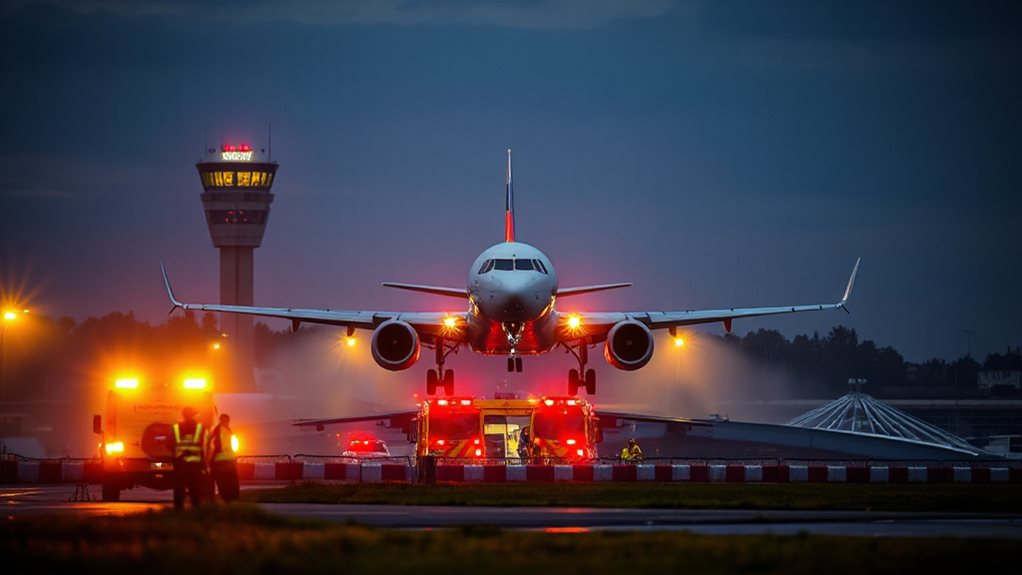
When a distress condition arises, you’ll declare it immediately—either by saying “Mayday” three times for a life‑threatening emergency or “Pan‑Pan” three times for a serious but non‑life‑threatening problem.
You then transmit your callsign, status, position, intended airport, runway, and ETE via voice, CPDLC DM56, or SSR.
ATC acknowledges, requests passenger and cargo details, applies ASSIST, clears airspace, vectors you to the nearest suitable runway, and prioritizes your landing while maintaining Aviate‑Navigate‑Communicate discipline.
Emergency Autoland systems may also automatically transmit the aircraft’s callsign, position, and intended landing airport to ATC.
Emergency Landing Procedures: Airport Runway Clearance & Crew Mobilization
After you’ve declared the emergency and ATC has assigned you a runway, the next step is securing that runway for your landing and mobilizing the airport’s emergency crew.
You’ll hear ATC pause all departures and arrivals, clear intersecting taxiways, and confirm your runway hold‑short position.
Simultaneously, the tower alerts RFFS, supervisors, and ground units, dispatching fire trucks, medical kits, and rescue personnel to pre‑designated spots.
The runway stays exclusive until you’ve touched down, taxied clear, and the crew confirms it’s safe to resume normal traffic.
Throughout the approach and landing, continuously monitor autopilot and flight systems to ensure safe and efficient performance.
Emergency Landing Procedures: Medical & Rescue Services Coordination
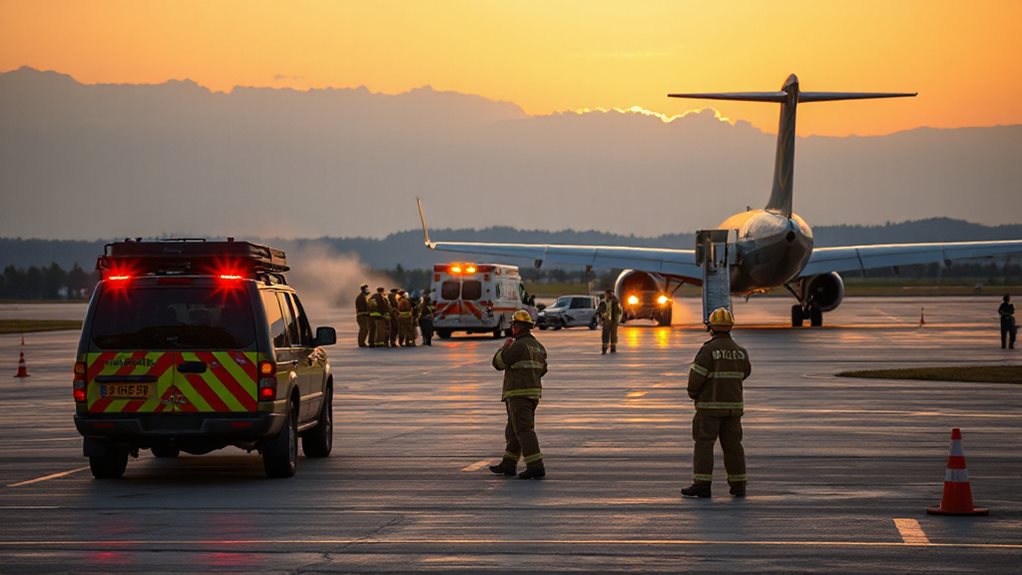
If a medical emergency arises mid‑flight, the crew’s first priority is to assess the passenger and secure the necessary equipment while staying in constant contact with ground medical consultants. You’ll also benefit from TCAS resolution advisories, which command immediate vertical maneuvers if an airborne threat is detected, helping the aircraft maintain safe separation while attention shifts to the medical situation. You’ll find first‑aid kits sized to seat count, an EMK with essential tools, and an AED trained attendants can use. Ground doctors guide you via satellite, while volunteers may assist. Airport fire‑rescue teams arrive within four minutes, ready for advanced life support and coordinated handoff to EMS.
Emergency Landing Procedures: Fuel‑Burn & Weight‑Reduction
Because a plane’s landing weight must stay below its structural limit, pilots often need to burn or dump fuel before an emergency touchdown. You’ll coordinate with ATC, climb above 10,000 ft, and release 3,000‑6,000 lb per minute per wing tank until weight drops to 155‑180 k lb. You may also be required to use high-altitude dumping so the fuel has time to evaporate before reaching the ground. You can also hold at cruise speed, lean the mixture, and use best‑glide settings to shed fuel efficiently before landing at the lowest safe airspeed.
Emergency Landing Procedures: Managing Runway, Off‑Airport, & Ditching Landings
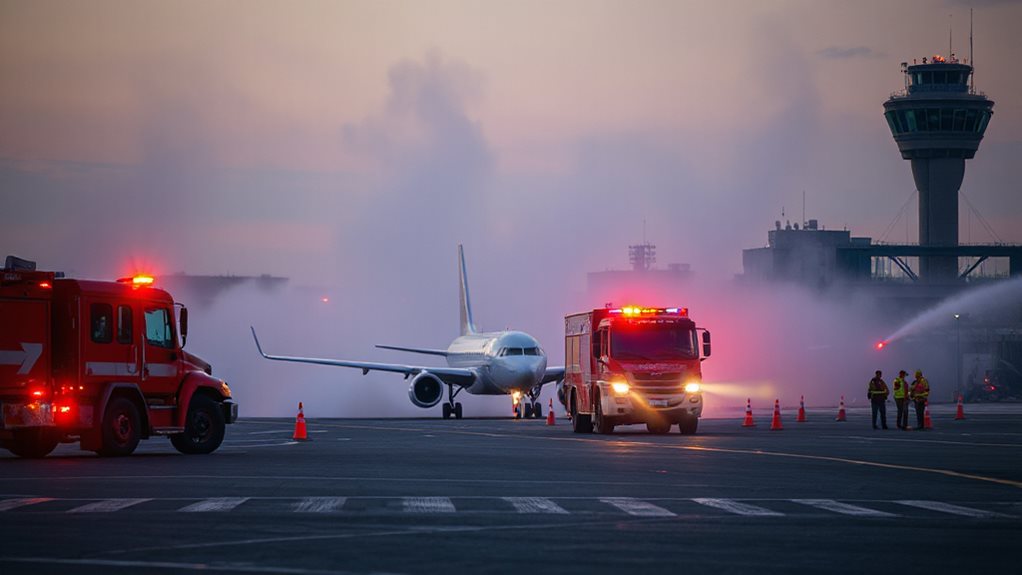
When an aircraft declares an emergency, the first priority is securing a safe landing surface, whether it’s a runway, an open field, or water.
You’ll contact ATC, declare the issue, and request priority; the runway is cleared, and a stable approach is required.
If the airport’s unreachable, you’ll climb for better communications, then consider off‑airport diversion or descending, activating the ELT and following ICAO distress procedures.
In commercial aviation, emergency situations are managed within rigorous safety protocols that rely on advanced technology and multiple backup systems.
Emergency Landing Procedures: Post‑Landing Passenger Care, Inspection, & Reporting
After the aircraft stops, you’ll see crews follow medical stabilization protocols, using AEDs, first‑aid kits, and supplemental oxygen while coordinating with ground medics for any needed transport.
At the same time, the fire‑fighting team and inspectors begin a systematic aircraft inspection, securing fuel, checking structural integrity, and verifying fire‑protection compliance.
Finally, the pilot’s emergency declaration triggers incident reporting, where you record clinical care, aircraft status, and any hazardous cargo on airline‑specific forms for regulatory review.
If luggage is missing after the landing, property irregularity report procedures help start a trackable claim through the airline’s baggage service desk.
Medical Stabilization Protocols
If an aircraft lands unexpectedly due to a medical emergency, the first priority is a rapid, organized assessment of every passenger’s health status.
You’ll see ground EMS meet the plane, receive crucial‑sign data logged in flight, and begin triage.
Patients stay supine with legs raised, receive oxygen, IV fluids, and CPR if needed.
Flight crew hands over detailed medical histories, symptom timelines, and treatment recommendations to the arriving medics.
Aircraft Inspection Procedures
The medical triage you just read about is only the first step; once passengers are stabilized, crews turn their attention to the aircraft itself.
You verify the primary switch, circuit breakers, and gear indicator lights, then move the gear lever to emergency down.
Using a flashlight, you scan wings, fuselage, and static wicks for ice or damage, confirming fuel pressure and engine security before clearing the runway.
Incident Reporting Requirements
Notify the NTSB immediately after an emergency landing, using the most expeditious method—phone, telegraph, or FAA dispatch—to report the event to the nearest NTSB Field Office.
You then give aircraft model, registration, pilot name, location, injuries, and circumstances.
File Form 6120.1 or 6120.2 within ten days for accidents; incidents are reported only when NTSB requests, attaching crew statements and supporting data.
Emergency Landing Procedures: Data‑Driven Improvements for Future Events
When an aircraft encounters a critical issue mid‑flight, pilots follow a set of data‑backed steps that aim to minimize risk and preserve lives. You’ll see them request assistance, climb for better radar, activate ELT, and transmit location details.
Data shows open fields cause 14% serious injuries, roads 40%, while off‑field survival exceeds the high 90s. Continuous tracking refines these procedures, reducing forced‑landing fatalities toward 10% and precautionary landings to 0.06%.
And Finally
By following a coordinated sequence—pilot declaration, ATC priority, runway clearance, crew mobilization, medical and rescue support, fuel‑burn, and,‑runway options—youensure that handle safely and efficiently efficiently incoming and post‑ crew detailed and, data‑driven reviews refine protocols, ensuring future emergencies are managed with equal precision and speed.