You’ll find a central server stores encrypted media and streams it through a cabin‑wide Ethernet and Wi‑Fi network to each seat’s playback unit, which may be a seat‑back screen or a BYOD device. The server sends filtered streams, while local storage on each seat holds a large cache of movies, music, and safety videos, allowing instant, jitter‑free playback. Satellite (JetWave, Ku‑Band) or LTE links provide internet and live TV, and the system includes redundancy, battery backups, and PRAM isolation for safety. Continue to uncover how these components interact and evolve.
TLDR
- A central server stores encrypted media and streams it via the aircraft’s wired or fiber network to seat‑back units or BYOD devices.
- Each seat has its own storage and playback engine, receiving filtered streams and caching content locally to reduce server load and enable instant playback.
- Wireless access points broadcast cabin Wi‑Fi, while satellite (Ku‑Band) or LTE links provide internet bandwidth for AVOD, live TV, and interactive services.
- Redundant power and PRAM modules isolate faults, keep screens and Wi‑Fi alive during power loss, and allow safe shutdown of faulty units.
- Future upgrades use AI‑driven personalization, 5G/LEO connectivity, and modular hardware to add new displays or sensors without major retrofits.
Inflight Entertainment System Overview
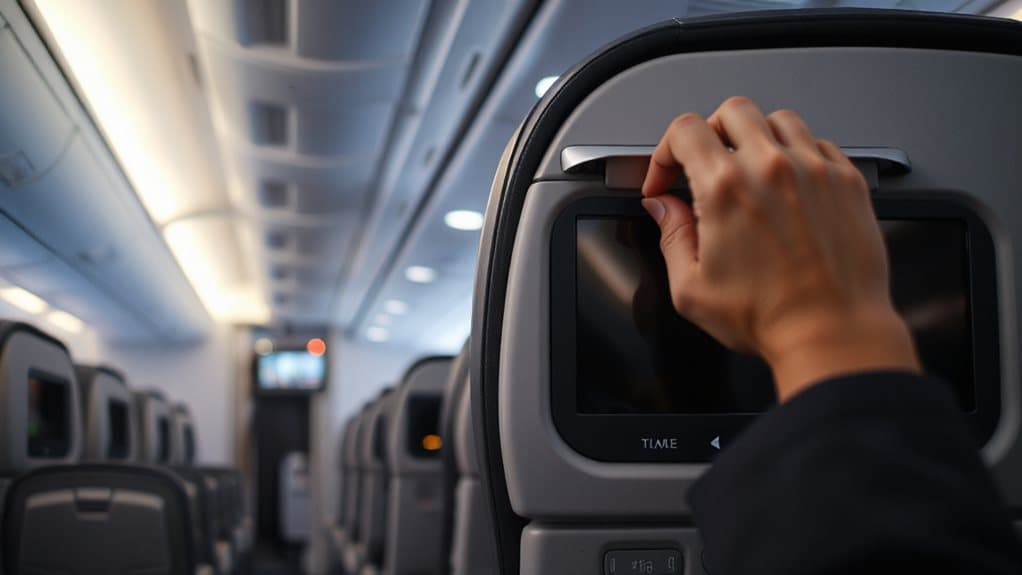
On a typical flight, the in‑flight entertainment (IFE) system delivers audio‑visual content to every seat, giving you movies, music, games and flight information at the push of a button. You’ll find seatback screens or BYOD apps, headphones that plug into armrests, and AVOD controls for pause and rewind. Wide‑body jets include cabin‑wide displays, while newer narrow‑bodies use drop‑down LCDs or personal devices, letting you stay connected and entertained. The first in‑flight television “media event” was shown in 1932 on a Western Air Express Fokker F.10 aircraft, marking the early AV era. Because inflight power banks follow airline carry-on rules (typically under 100 Wh) they can help passengers keep phones and tablets charged for BYOD entertainment during layovers and flights.
Core Architecture of Inflight Entertainment Systems
You’ll see that the core design rests on a central server system that stores and encrypts all media before sending it through the aircraft’s network.
Each seat has its own storage module that receives filtered streams from the head‑end, letting passengers pick content locally without overloading the main server.
A wireless connectivity layer ties everything together, providing Wi‑Fi, live TV, and second‑screen services while managing bandwidth and synchronization.
Central Server Architecture
Because the IFE experience hinges on a single source of truth, the central server acts as the brain of the entire cabin network.
You’ll find a 4‑MCU Intel Xeon‑based engine, up to 22 TB SSD storage, 64 GB RAM, and 12 GbE ports feeding wired and wireless links.
It streams media via fiber, Wi‑Fi to WAPs, and satellite, while Linux or Windows APIs manage apps, DRM, and crew services.
Modularity lets you swap modules without downtime.
Seat‑Centric Storage
The central server’s role as the cabin’s brain gives way to a seat‑centric approach, where each seat‑back display houses its own storage and playback engine.
You’ll find up to one terabyte per seat, holding thousands of hours of HD movies, music, and safety videos.
If one unit fails, neighboring seats can supply the missing files, keeping entertainment alive without network dependence.
This design cuts weight, wiring, and cost while providing instant, jitter‑free playback.
Wireless Connectivity Layer
If the aircraft’s entertainment system needs to keep every seat‑back display synced and responsive, it relies on a layered wireless connectivity architecture that bridges the on‑board server hub with passenger devices. On‑board servers store and stream content, while WAPs broadcast Wi‑Fi across the cabin via Ethernet or fiber links.
Satellite or ATG modules supply internet, and adaptive software reallocates bandwidth to keep streams smooth for every traveler.
JetWave, Ku‑Band & LTE Connectivity for Inflight Entertainment
You’ll notice that JetWave’s satellite performance delivers up to 40 Mbps of broadband, keeping video streams smooth even at cruising altitude. The Ku‑Band antenna adds higher‑frequency capacity, often exceeding 100 Mbps, which reduces latency for interactive services. Meanwhile, LTE integration via JetWave X lets the cabin switch to ground‑based networks when available, ensuring consistent streaming for passengers and crew. However, phone airplane mode prevents cellular hotspot/tethering from working during flight, so inflight connectivity relies on the airline’s system instead.
JetWave Satellite Performance
When you board a jet equipped with JetWave X, the system instantly taps into multiple satellite networks—including Inmarsat Global Xpress, the upcoming ViaSat‑3, and future Ka‑band constellations—to deliver high‑speed connectivity for inflight entertainment.
You’ll enjoy up to 200 Mbps download speeds, with the fuselage antenna reaching 50 Mbps and the tail antenna 33 Mbps.
The ADC automatically switches to the best link, prioritizes traffic, and maintains a single IP address for seamless streaming.
Ku‑Band Frequency Advantages
JetWave’s satellite link already taps multiple constellations, and the real advantage comes from the Ku‑band range it uses for both satellite and LTE connectivity.
You benefit from 12‑18 GHz wavelengths that cut interference by up to 70 %, resist rain fade, and enable 0.6‑1.2 m dishes.
Smaller antennas lower cost, simplify licensing, and support 150 Mbps‑plus throughput, giving you reliable, high‑capacity entertainment on‑board.
LTE In‑Cabin Streaming
Use the aircraft’s onboard LTE link to stream entertainment directly to passenger devices without the latency of a satellite hop.
You connect to ground cell towers via a small fuselage antenna, creating a 4G small cell that delivers up to 75 Mbps.
The system works alongside JetWave Ka‑band satellite, offering low‑latency, HD streaming, seamless handoffs, lighter equipment, and cost‑effective, flexible capacity for unrestricted in‑flight freedom.
Central vs. Seat‑Centric Content Storage Models
Because airlines need to supply movies, games, and other media to every passenger, they can choose between a central storage model and a seat‑centric model. A central system stores everything on one onboard server and pushes it through cables to each seat, which is reliable but costly and vulnerable to a single failure. Seat‑centric boxes hold content locally on SD cards, cutting wiring, easing updates, and letting each seat operate independently. TSA officers make final determinations in security screening, which is a useful analogy for how a single decision point can affect outcomes.
Streaming Technologies for Inflight Entertainment: AVOD, Live TV, BYOD
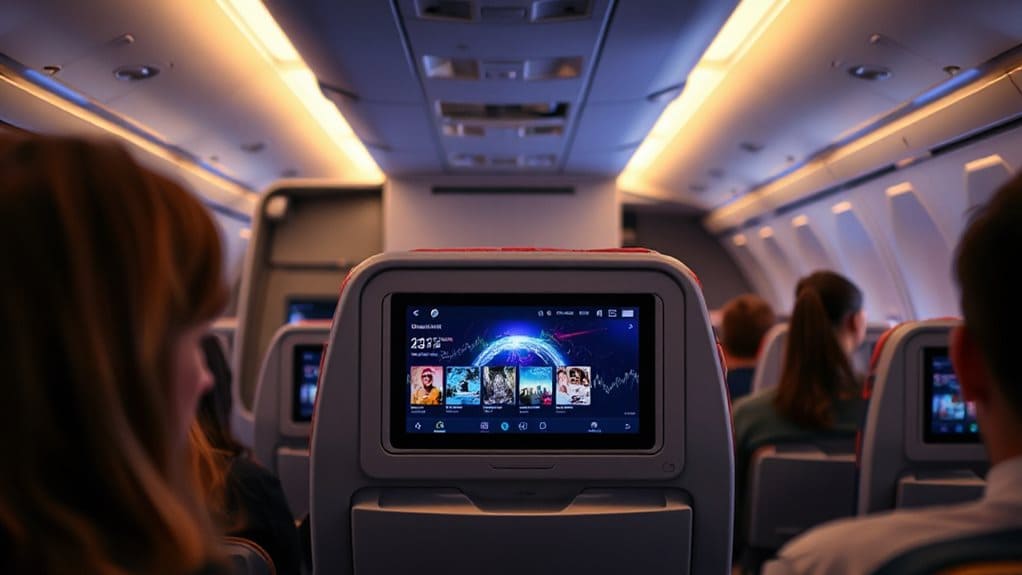
AVOD and BYOD have reshaped how airlines deliver entertainment, moving the content from heavy seat‑back hardware to passengers’ own devices.
You stream movies, music, and shows directly to your phone via a lightweight Wi‑Fi server that weighs only a few pounds, cutting cabin weight and costs.
No app downloads are needed; a browser connects instantly, letting you start before take‑off and resume mid‑flight, while airlines save millions on installation and maintenance.
Add-on in‑flight Wi‑Fi can also support internet-based messaging apps like WhatsApp and Facebook Messenger while cellular remains disabled in airplane mode.
Interactive Features in Inflight Entertainment: Moving Maps, Flight Data, In‑Seat Gaming
You’ll find that modern inflight entertainment systems let passengers interact with moving maps, real‑time flight data, and in‑seat gaming—all from the same seatback or personal device.
You can zoom 4K 3D maps, tap points of interest, and overlay live altitude, speed, and wind info from ADS‑B feeds.
Games launch instantly, and AR layers add weather or destination guides, all while you stay in control.
These interactive features are typically supported by quick TSA access so you can manage onboard controls and related essentials without delays.
Safety & Compliance in Inflight Entertainment: Multi‑Language Videos, Subtitles, PRAM Integration
Safety and compliance in inflight entertainment revolve around three key elements—multi‑language videos, subtitles, and PRAM integration—each of which must meet strict regulatory standards while remaining invisible to the passenger experience.
You guarantee video streams stay on non‑essential power buses, follow EASA EMC limits, and avoid distracting safety briefings.
Subtitles connect to utility buses, meet DO‑254 DAL E hardware rules, and prevent fire hazards.
PRAM modules isolate fault paths, allow power removal during smoke events, and stay classified as no‑effect on flight controls.
Maintenance & Redundancy for Inflight Entertainment: Fault Tolerance, Neighbor Replication, Updates
When an IFE system loses its primary power source, its built‑in battery backup kicks in, keeping seat‑back screens, wireless access points, and control panels alive long enough for crew to intervene. You may also notice TSA emphasizes that spare lithium batteries should be kept in carry-on rather than checked bags, reflecting the broader safety importance of battery handling. You’ll see fault‑tolerant construction with redundant cables, neighbor‑panel replication, and automatic failover. Regular 25‑hour checks, 100‑hour inspections, and annual audits guarantee batteries stay healthy, while updates propagate through multiple servers, preserving uninterrupted entertainment.
Future Trends in Inflight Entertainment: AI‑Personalization, Modular IFEC, Fully Wireless Cabins
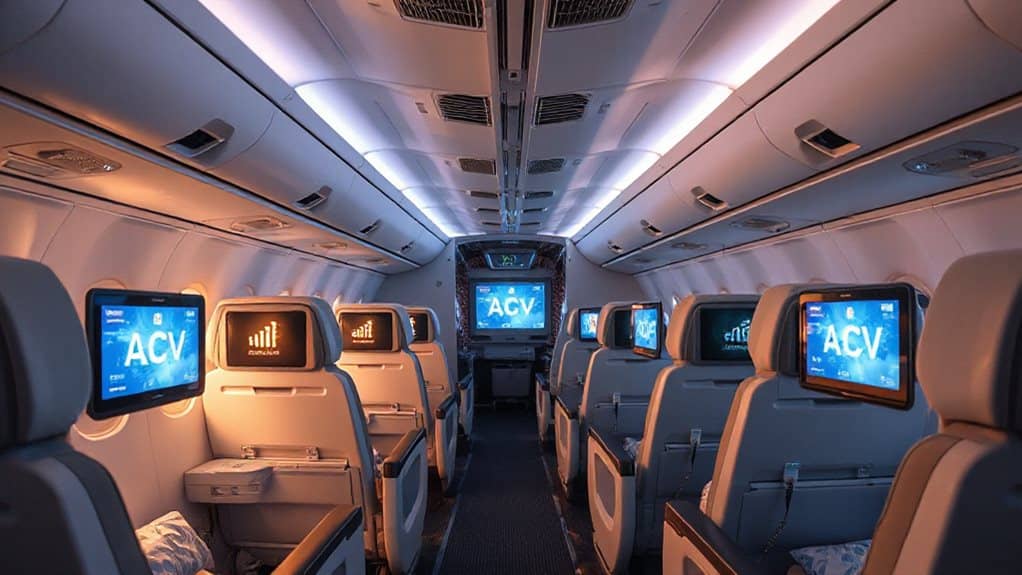
As 5G and low‑earth‑orbit satellite constellations mature, airlines are reshaping in‑flight entertainment with AI‑driven personalization, modular IFEC hardware, and fully wireless cabins.
You’ll see AI curating movies, music, and games to your taste, while edge‑cloud streams keep latency low.
Modular seats let airlines upgrade displays and sensors without major retrofits.
Wireless cabins eliminate cables, granting you unrestricted movement and seamless connectivity throughout the flight.
And Finally
You’ve seen how inflight entertainment systems blend reliable hardware, high‑speed connectivity, and adaptable content delivery to keep passengers engaged. Modern IFECs balance central and seat‑centric storage, support streaming options like AVOD and live TV, and offer interactive features such as moving maps and in‑seat gaming. Safety protocols confirm multilingual compliance, while redundant and regular updates maintain sturdy. Looking ahead, AI‑driven personalization, modular designs, and fully wireless cabins will further enhance the passenger experience.