
An airport hub is a central airport where airlines concentrate flights so passengers and cargo can transfer efficiently across a hub‑and‑spoke network. By routing many city‑pairs through one node, hubs enhance load factors, lower per‑passenger costs, and enable high‑frequency connections that power airline alliances and code‑sharing. They also streamline cargo logistics, reduce empty seats, and improve travel times. You’ll see how these benefits shape modern air travel as you examine further.
TLDR
- An airport hub is a central node where flights converge, allowing passengers to transfer between many origins and destinations.
- Hub‑and‑spoke networks increase load factors and reduce empty seats, lowering per‑passenger operating costs.
- Strategic geographic placement captures regional demand and shortens drive‑time catchment zones, boosting passenger volumes.
- Hubs enable dense alliance connections, seamless code‑sharing, and faster, coordinated transfers for travelers.
- Cargo hubs centralize freight sorting and consolidation, improving logistics efficiency and reducing aircraft utilization.
Airport Hub Definition & Core Features

If you’re looking at how airlines organize their routes, an airport hub is fundamentally the central node where flights converge and passengers transfer to reach their final destinations.
You’ll find it concentrates traffic, offers extensive domestic and international connections, and hosts multiple runways and terminals.
Large hubs handle over 40 million passengers yearly, using advanced technology to streamline turn‑arounds, processing, and cargo redistribution efficiently.
Airport hubs connect major routes and act as the backbone of the aviation industry, supporting global passenger routing through centralized connectivity.
Hub‑and‑Spoke vs. Point‑to‑Point Flights
After learning what makes an airport hub a central node, it’s useful to compare the two main network designs airlines use: hub‑and‑spoke and point‑to‑point. Hub‑and‑spoke routes all flights through a central airport, letting you reach many cities with fewer routes and higher frequencies, but you may face transfers and congestion. Point‑to‑point offers nonstop service, cutting travel time and baggage hassles, yet it only serves city pairs with sufficient demand. Both models have trade‑offs, and many carriers now blend them for flexibility. real-time pricing uses demand and load-factor information to adjust fares dynamically by route.
Types of Airport Hubs: Global, Regional, Low‑Cost, Cargo
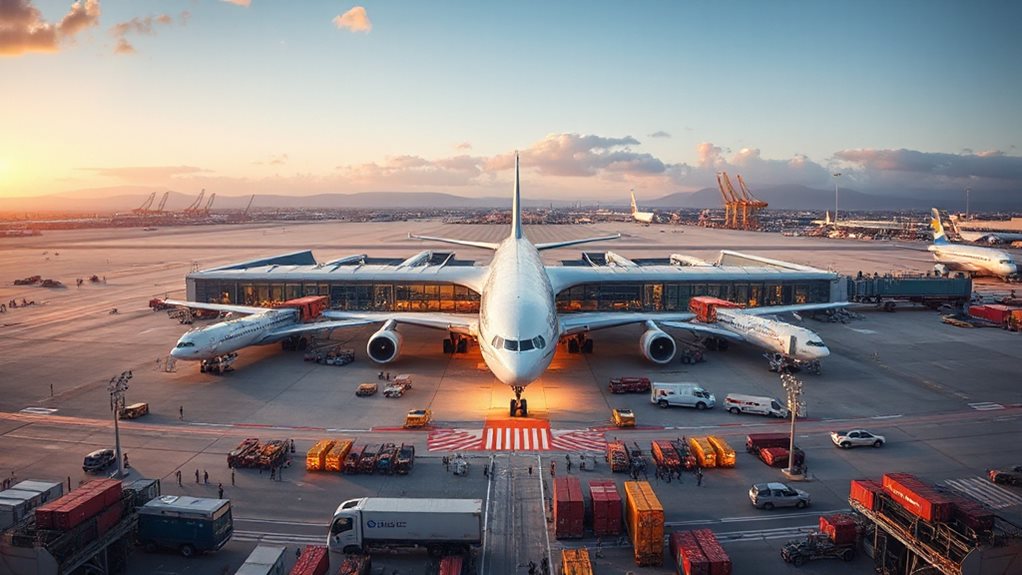
When you look at airport hubs, they fall into distinct categories—global, regional, low‑cost, and cargo—each serving a specific role in airline networks. Global hubs like Heathrow or Dubai connect hundreds of destinations and belong to alliances.
Regional hubs such as Schiphol link nearby cities to those networks.
Low‑cost hubs operate from secondary airports, emphasizing point‑to‑point flights.
Cargo hubs like Memphis focus on freight transfers and rapid turnaround.
Geographic Location & Population Density in Hub Success
You’ll find that a hub’s strategic central position lets it link major traffic corridors efficiently, while a high‑population catchment supplies a steady flow of origin‑and‑destination passengers.
Being close to large urban centers reduces travel time to the airport and enhances local demand, which in turn raises yields and supports frequent connections.
Together, these geographic and demographic factors create the conditions for a hub to dominate its region and sustain growth.
Strategic Central Position
Where does a hub’s geographic centrality matter most? You’ll find it where routes converge, slashing connection times and enhancing travel efficiency.
A central location creates natural flow patterns, letting airlines route flights without costly incentives.
It also captures traffic that would otherwise bypass the region, turning the airport into a powerful gateway that draws airlines and passengers alike.
High Population Catchment
Why does a hub’s population catchment matter? You tap into a 60‑ to 90‑minute drive‑time zone, capturing residents and businesses that form your traveler pool.
High density inflates the Huff model’s distance‑decay calculations, expanding realistic catchment boundaries.
Census tracts, ZIP‑code surveys, and SafeGraph mobility data reveal the true pool, enhancing hub connectivity and flight options.
Proximity to Major Corridors
How close you’re to the major continental and intercontinental traffic corridors can make or break a hub’s viability. Being near primary traffic flows raises load factors and flight frequencies, while misalignment limits indirect market service.
Proximity to dense urban centers fuels captive origin‑and‑destination demand, and central positioning strengthens carrier dominance.
Strong landside accessibility and single‑terminal efficiency further enhance connectivity and profitability.
Why Airlines Build Hubs for Economies of Scale & Higher Load Factors
You’ll see that consolidating city‑pairs at a hub lets you fill each flight with passengers from multiple origins, which maximizes aircraft utilization.
By routing traffic through a central point, you increase the load factor on every leg, turning otherwise empty seats into revenue.
The result is higher revenue per flight and lower per‑passenger costs across the network.
Because airlines also manage cabin space and safety constraints efficiently, you may notice how exit row legroom can come with trade-offs like fixed armrests and limited recline that affect passenger comfort.
Consolidate City‑Pairs
When airlines adopt a hub‑and‑spoke model, they funnel passenger traffic from many city‑pairs into a single airport, which lets them schedule flights more efficiently and cut operating costs.
You’ll see that consolidating routes concentrates demand, lifts load factors, and lets carriers invest in terminals with predictable revenue.
Central locations, like Memphis, pull regional traffic together, enabling higher seat‑utilization and economies of scale while preserving competition across overlapping markets.
Maximize Aircraft Utilization
Airlines routinely build hubs to squeeze every possible minute of aircraft time out of their fleets, because concentrating flights at a single airport lets them schedule departures and arrivals in tight, high‑frequency blocks.
You’ll see aircraft flying more cycles per day, higher seat‑kilometers, and load factors above 83 %, because hubs streamline inbound‑outbound matching, cut turn‑around times, and let carriers reach economies of scale that enhance overall fleet productivity.
Boost Revenue Per Flight
By consolidating flights at a hub, airlines can squeeze more revenue out of each departure because the model spreads fixed costs—like airport fees and ground handling—across a higher volume of aircraft.
You’ll see higher load factors, often above 80 %, and lower per‑flight expenses from shared services and bulk fuel deals.
These economies of scale enhance per‑flight earnings, turning each departure into a more profitable, freedom‑enabling operation.
What Infrastructure Makes a Hub Airport Work?
Optimizing a hub airport starts with a durable physical structure that can handle high traffic volumes and diverse aircraft. You need runways sized for different planes, solid taxiways that keep movement smooth, and capacity assessments that match forecasts. Terminals must expand gates, streamline baggage, and integrate security tech. Utilities, communications, and intermodal links—rail, highways, freight corridors—complete the ecosystem, ensuring reliable, scalable operations. TCAS core function and other airborne collision-avoidance layers help ensure safe movement when aircraft density increases around hub operations.
How Hub Airports Facilitate Airline Alliances & Code‑Sharing

You’ll see how strategic alliance integration turns a hub into a central exchange point, letting partner airlines share routes and schedules without extra aircraft.
The hub’s infrastructure supports seamless code‑sharing, so a single ticket can cover multiple carriers and passengers enjoy coordinated check‑in, baggage handling, and transfers.
This coordination not only expands destination choices but also cuts costs and reduces travel time for everyone involved by enabling airlines to align inventory and fare rules across shared markets, including fare seat inventory management.
Strategic Alliance Integration
At a hub airport, airlines can weave their networks together, turning a single carrier’s routes into a web of shared connections that fuels alliances and code‑sharing.
You benefit from denser routes, as SkyTeam at Schiphol and Star Alliance at Chicago enhance indirect links into near‑direct options.
Joint procurement, unified revenue tools, and shared loyalty programs cut costs, while hub‑hub routes lift passenger traffic by roughly ten percent within two years.
Seamless Code‑Sharing Networks
Because hub airports concentrate flights from multiple alliance partners, they become the natural stage for seamless code‑sharing networks.
You’ll find a single booking reference covers seats on any partner’s plane, while integrated ticketing, baggage, and check‑in cut delays.
Hubs like Heathrow link 59,000 connections, enhancing alliance reach without extra aircraft.
This unified system drives revenue sharing, faster transfers, and greater travel freedom.
Passenger Benefits: Faster Connections & Shorter Travel Times
When airlines group flights into waves, hub hubs, your connection times shrink dramatically. You’ll hop between flights in minutes instead of hours because hubs schedule banks of departures that line up transfers. A key advantage is frequent scheduling, which helps reduce the risk of long waits during your connection. High frequency and strategic locations cut overall travel duration, while consolidated passenger flows reduce bottlenecks. The result is a smoother, faster trip that frees you to reach your destination sooner.
Cargo Hub Advantages: Streamlined Freight Logistics

Cargo hubs streamline freight logistics by concentrating shipments into a centralized hub‑and‑spoke network, which lets you sort, consolidate, and redirect cargo efficiently.
You benefit from reduced aircraft needs, higher load factors, and larger, more efficient planes handling millions of tonnes annually.
Automation and smart warehousing speed tracking and delivery, while dense flight connections cut transfer times and expand global trade possibilities.
Key Hub Examples: Dubai, Amsterdam, Atlanta, Memphis, Louisville
There are several standout airport hubs that illustrate how geography, infrastructure, and airline strategy combine to shape global connectivity. Dubai links continents with massive passenger volumes and state‑of‑the‑art terminals. Amsterdam offers sophisticated technology and seamless transfers.
Atlanta handles over 40 million travelers with optimized turnarounds. Memphis and Louisville serve as FedEx and UPS cargo superhubs, positioned near the U.S. population center for rapid freight distribution.
And Finally
Now now see why airport hubs matter: they concentrate traffic, cut costs, and enhance airline efficiency. By linking spokes to a central point, hubs enable higher load factors, smoother connections, and faster travel for passengers. Cargo hubs streamline freight, supporting global supply chains. Whether global, regional, low‑cost, or cargo‑focused, a hub’s location and population density drive its success, making it a critical element in modern aviation networks.