
When fog drops visibility below a kilometre, you rely on the ILS’s localizer and glideslope beams to keep the aircraft centered and on a 3‑degree descent path. You intercept the glideslope at the final approach fix, follow autopilot cues, and watch for at least one of ten prescribed visual references at decision height. If none appear, you execute a missed approach immediately. The system’s redundancy and strict checks let you land safely, and the next sections reveal more details.
TLDR
- Aircraft use ILS (localizer and glideslope) to follow precise radio‑guided lateral and vertical paths when visual cues are unavailable.
- Low‑visibility approaches are classified (CAT I‑IIIC) with specific decision heights and runway visual range minima, dictating required equipment and crew currency.
- Pre‑approach checks verify ILS integrity, RAAS, autopilot redundancy, and sensor health to ensure fail‑operational capability after a single failure.
- At the decision height, pilots must obtain at least one prescribed visual reference; if none appears, a missed approach is executed immediately.
- Autopilot and flight‑control redundancy, combined with continuous monitoring of ILS, radio altimeter, and GPS, maintain safe descent and allow safe go‑arounds in fog or ice‑fog conditions.
Low‑Visibility Landing: How Fog Reduces Airport Visibility

When fog settles over an airport, it creates a thin layer of microscopic water droplets—typically about 10 µm in diameter—that scatter light and cut horizontal visibility to less than 1 km, the threshold that defines low‑visibility conditions for aviation.
You’ll see shallow fog under two meters deep, or ice fog that adds runway icing risk.
Visibility can drop from VFR to IFR in minutes, throttling arrivals, departures, and taxi flow, and forcing diversions or delays that cost airlines and passengers alike.
Poor visibility can increase accident risk, so air traffic control and pilots may have to slow down or halt operations until conditions improve.Low‑visibility conditions can be deadly for less‑skilled pilots.
Low‑Visibility Landing Categories: CAT I‑IIIC Explained
If the runway’s visibility drops below the thresholds for standard visual approaches, pilots must rely on instrument‑based categories—CAT I through CAT IIIC—to determine how low the decision height can be and what runway visual range (RVR) is acceptable.
CAT I needs 60 m DH and 550 m RVR; CAT II lowers DH to 30 m with 300 m RVR and redundant ILS.
CAT IIA allows DH below 30 m or none, RVR 175 m.
CAT IIIB drops DH to 15 m or none, RVR 50‑175 m.
CAT IIIC removes DH and RVR limits, demanding full redundancy.
Thunderstorm radar can also help pilots avoid hazardous weather when conditions aren’t suitable for a safe approach.
Low‑Visibility Landing Path: Localizer and Glideslope Guidance

Because low‑visibility approaches rely on radio guidance rather than sight, the localizer and glideslope together form the backbone of the Instrument Landing System.
The localizer sends a 700‑foot‑wide VHF beam from the runway’s far end, letting you know when you’re left, right, or on the centerline.
The glideslope transmits intersecting 90 Hz and 150 Hz beams from a nearby antenna, defining a 3‑degree descent path and a 50‑foot threshold crossing height.
You intercept the glideslope at the final approach fix, then follow it, correcting any half‑scale deviation before a missed approach.
Low‑Visibility Landing Equipment Checks Before Approach
Before you start the approach, you verify that the ILS is fully inspected and all required lights, transmitters, and sensors are operational. You then confirm the pilot briefing, making sure every crew member understands the low‑visibility procedures and the specific equipment status. This quick checklist ensures you’re ready for a safe landing even when visibility drops below normal levels, while TCAS limitations are kept in mind to avoid complacency about traffic awareness.
ILS Inspection
During low‑visibility operations, pilots rely on a fully inspected ILS before beginning the approach, because any fault in the localizer or glideslope could compromise safety.
You verify that periodic inspections occur every 540 days for ILS and LDA/SDF, with a 90‑day check after reconfiguration and a 270‑day follow‑up.
Localizer single‑frequency checks cover alignment, modulation, and alarm settings, while dual‑frequency checks add course‑wide and clearance‑wide alarms.
Glideslope inspections confirm UHF transmission, sideband reference, and capture‑effect hardware, using software‑driven monitors and remote CST sessions.
All results are logged in the Daily Flight Log, ensuring the facility meets decision‑altitude criteria.
Pilot Briefing Confirmation
When you’re about to begin a low‑visibility approach, the pilot briefing must confirm that every piece of landing equipment is ready and that the crew understands the specific constraints of the operation.
Verify CAT II/III systems, RAAS, external lights, and seat‑ball visibility.
Check ATC RVR, minima, and NOTAMs.
Review crew currency, go‑around plans, and autopilot callouts.
Make sure all checks are logged before descent.
Low‑Visibility Landing: Fail‑Operational Systems Required for CAT III?
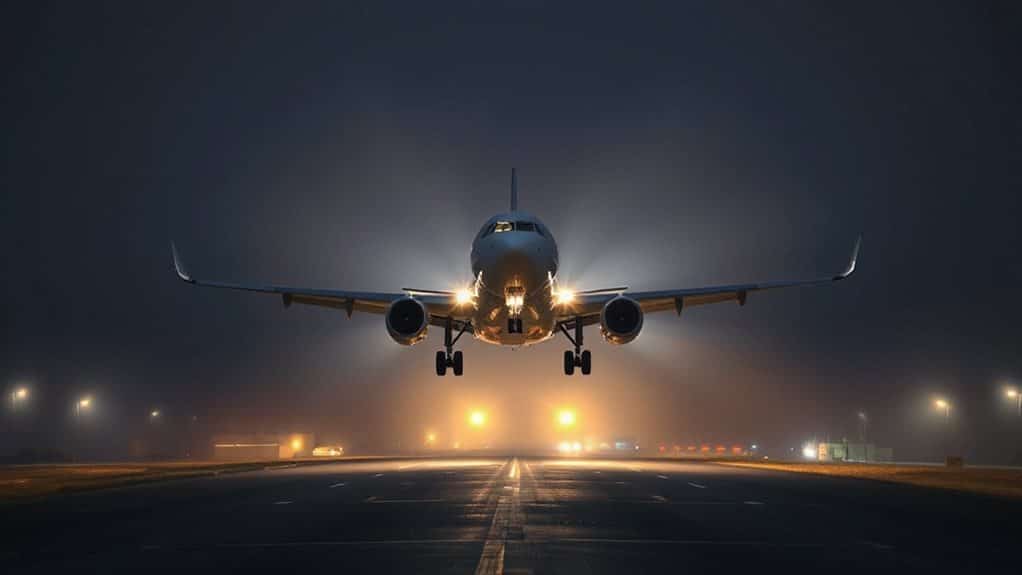
You’ll notice that CAT III operations demand operational redundancy, with at least two independent autopilot or flight‑control channels that stay functional after a single failure.
The aircraft’s sensor suite must fuse data from ILS, radio altimeters, and GPS while continuously monitoring health to trigger a fail‑operational response.
Certification and maintenance rules require rigorous testing, documented inspections, and approved procedures to keep those redundant systems reliable throughout the flight.
In contrast, cabin pressure changes can introduce risks for onboard devices like pepper spray because expanding gases may leak or cause unintended discharge.
Operational Redundancy Requirements
Because a CAT III approach must be completed even after a single system failure, the aircraft’s landing design has to be fail‑operational—meaning at least two independent automatic systems must remain functional from the decision height through touchdown and rollout.
You’ll find three autopilots or dual‑redundant flight‑control computers common, with separate hydraulic, electrical, and sensor paths.
Ground ILS, backup transmitters, and full runway lighting also provide parallel fail‑safe channels, ensuring the aircraft stays on course despite any one‑‑ outage.
Sensor Fusion and Monitoring
If you’re flying a CAT III approach, the aircraft’s sensor‑fusion design must stay operational even after a single‑system failure, because the landing guidance relies on continuous, high‑precision pose estimates from multiple sources.
EKF blends visual, IMU, and GNSS data, shifting weight to camera near touchdown for sub‑meter accuracy.
IMU fills GN visual/GNSS gaps, while cross‑checks flag degraded inputs.
Surveillance fusion—AMASS, ARTS, radar, LIDAR—prevents runway incursions and enhances situational awareness.
Certification and Maintenance Standards
When an aircraft seeks CAT III certification, every component of its low‑visibility landing system must be proven fail‑operational, meaning it can continue to provide accurate guidance even after a single‑system failure.
You must obtain OpSpec/MSpec/LOA C060, meet Order 8400.13F ground‑equipment standards, and secure phase‑three avionics approval.
Dual autopilot, radio‑altimeter decision height, and strict wind limits are mandatory, and crew must hold instrument‑rated type‑rating with required night and instrument hours.
Low‑Visibility Landing: Pilot Actions for a Missed Approach in Fog
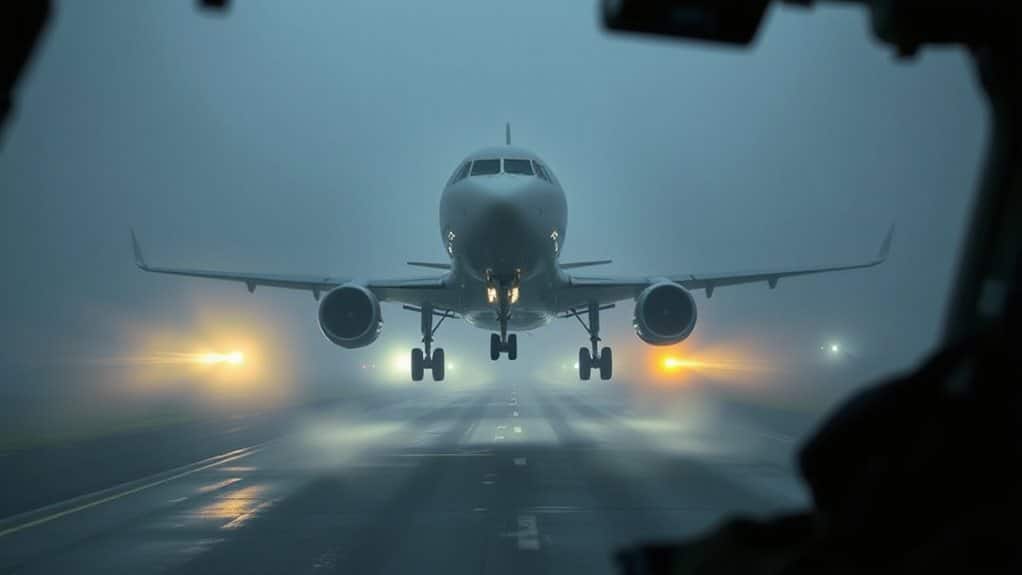
In low‑visibility conditions, a missed approach is triggered the moment you reach the missed approach point (MAP) without a visual reference to the runway environment, even if you’re still above the decision altitude or minimum descent altitude. When you enter fog and lose the visual picture, the airplane must execute the published missed approach. You call “missed approach,” apply full power, set climb attitude, and verify mixture rich. Retract flaps gradually, keep VY pitch, and follow the published climb‑out course while informing ATC.
Low‑Visibility Landing: Autoland and Auto‑Throttle Mechanics
After you’ve executed a missed approach, the next step in low‑visibility operations is to let the aircraft’s autoland system take over.
The autopilot locks onto the ILS localizer and glideslope, while the autothrottle maintains the correct approach speed.
At about fifty feet, the system flares, reduces thrust, and deploys brakes, spoilers, and reversers, ensuring a precise touchdown even if one autopilot fails.
During the approach, pilots still maintain vigilance in crowded skies.
Low‑Visibility Landing: Visual Cues at Decision Height

If the runway isn’t clearly visible at Decision Height, you must obtain at least one of the ten prescribed visual references before you can continue the descent.
You’ll scan for threshold lights, runway edge markers, or approach lights extending beyond the runway end.
When none appear, you execute a missed approach immediately.
Higher ILS categories lower the required visual range, but the rule stays the same.
And Finally
In low‑visibility conditions, you rely on precise instrument guidance, rigorous equipment checks, and strict adherence to CAT I‑III procedures. Autoland and auto‑throttle systems keep the aircraft on the localizer and glideslope, while pilots monitor performance and be ready for a missed approach if visual cues don’t appear at decision height. Understanding these components helps guarantee safe landings when fog or other factors limit visibility, and it highlights the importance of thorough training and reliable technology.