You start by spelling your call sign with the ICAO phonetic alphabet, then state who you are, where you’re at, and what you need using the Four‑W and Four‑X models—facility, call sign, direction or distance, altitude, and intention. Keep each transmission short, use standard phraseology, and read back every clearance element exactly as given, including your call sign. Switch frequencies with a clear hand‑off and use CPDLC when available to cut voice traffic. If you make a mistake, say “Correction” and repeat the correct information. Continuing will reveal more details.
TLDR
- Use the ICAO phonetic alphabet to spell the aircraft call sign on the first transmission to an ATC facility.
- State position with the Four‑X model: facility, call sign, direction/distance from a known reference, and altitude.
- Keep each transmission concise, using standard phraseology (e.g., “Roger,” “Wilco”) and a single sentence per request.
- Read back every clearance element in exact order, including the call sign, and avoid “Roger” or “Wilco” as a substitute for a full readback.
- Prioritize and execute Resolution Advisories (RA) over ATC instructions, hand‑fly the maneuver, then announce “Clear of conflict” after separation.
Initiate Pilot‑Controller Contact Using the Phonetic Alphabet

When you first call an ATC facility, you must spell your aircraft’s call sign with the ICAO phonetic alphabet, and this practice guarantees that the controller hears exactly what you intend. You’ll say “Alfa‑Bravo‑Charlie” for ABC, using standardized words that cut through noise and language barriers.
This mandatory step prevents mis‑hearing, especially when frequencies are busy or weather degrades audio quality, ensuring clear, reliable identification before any instructions follow. The ICAO alphabet was developed after reviewing over 200 phonetic systems, standardizing global communication for aviation.
Adding correct ICAO phonetic spelling helps reinforce clear identification during initial contact with ATC.
Maintain Brevity in Pilot‑Controller Exchanges
If you keep each transmission focused on the essential data, you’ll prevent the frequency from becoming clogged and give controllers the time they need to issue timely instructions.
Stick to standard phraseology—“Roger,” “Wilco,” “Negative”—and omit any non‑essential details after the initial call‑sign.
Speak at a measured pace, think before you press the mic, and use a single, concise sentence for each request.
This preserves safety, reduces delays, and keeps the airspace flowing smoothly, especially when night safety depends on quick, clear communication.
Apply the Four‑W Framework for Clear Calls

When you call ATC, start by stating your aircraft identification, then give your exact position, and finish with a concise declaration of what you need. This three‑part structure—who you are, where you are, and what you want—keeps the transmission clear and reduces the chance of misunderstandings. To support TCAS conflict awareness, be sure your call includes any requested altitude or maneuver changes promptly and in plain language.
Identify Aircraft
You’ll start by applying the Four‑W model—who, what, where, and why—to make each identification call unmistakable.
Use primary radar to match a target within one mile of the runway, confirm with pilot reports, and check heading.
For SSR/MLAT, verify the discrete code, avoid “00” endings, and listen for IDENT.
With ADS‑B, read the transmitted ID and confirm compliance.
If doubt remains, re‑identify or terminate service.
State Position Clearly
Using the Four‑X model, you state your position by naming the facility, your call sign, the direction and distance from a known reference, and your altitude.
You might say, “Oakland Tower, Cessna 123AB, five miles east, 3,500 feet.”
This format gives ATC the exact location they need, keeps the transmission brief, and reduces misunderstanding risk.
Declare Intentions Concisely
Because ATC must know exactly what you need, you should state your intent in a single, concise sentence that follows the Four‑W pattern: who you’re calling, who you are, what you want, and how you’ll keep the exchange professional.
Call the appropriate frequency, announce your callsign, request takeoff or landing, and use standard phraseology to stay clear and efficient.
Execute a Correct Readback for Pilot‑Controller Instructions
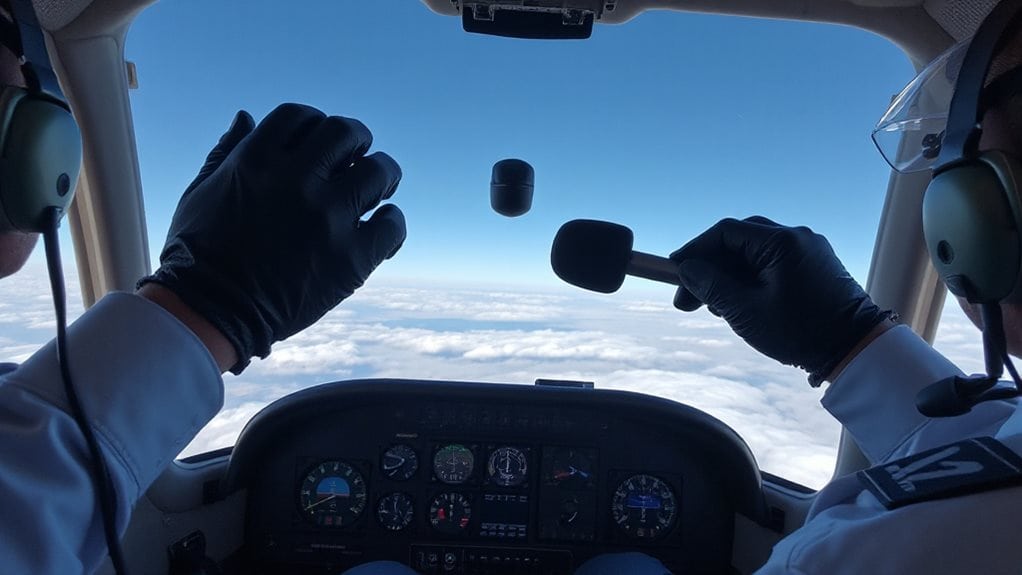
When you receive a clearance, repeat every element—aircraft ID, heading, altitude, speed, runway, and hold instructions—in the exact order the controller gave them, and do it promptly after the transmission. Speak clearly and enunciate each number or code to avoid common pitfalls like misreading “one zero” for “one one thousand” or swapping left/right runway designations. TCAS Resolution Advisories can require immediate vertical maneuvering and take priority over ATC instructions when a conflict threat is detected, so your readback accuracy still matters for coordinated control outside those urgent scenarios. The controller will then confirm your readback or issue a correction, completing the closed‑loop verification that keeps the flight safe.
Readback Elements
If you’re a pilot, executing a correct readback means repeating the controller’s instruction verbatim, preserving the exact sequence and including every critical element—call sign, action verb, runway designator, altitude, speed, and any other specified parameters.
You must echo route clearances, runway assignments, altimeter settings, transponder codes, and heading or speed changes in the same order given.
Call sign follows the information, and you avoid “Roger,” “Wilco,” or “Copied.”
This closed‑loop ensures safety and prevents hear‑back errors.
Timing And Clarity
You repeat altitude, vector, and runway data in the exact order given, include your call sign, and avoid “Roger” or “Wilco.”
Speak promptly after the instruction, and if you’re unsure, say “Say again.”
Controllers listen for errors, correct them instantly, and confirm you’ve received the clearance correctly.
Common Pitfalls To Avoid
Because a single misstep can break the safety loop, pilots must watch for the most common readback pitfalls and correct them immediately.
Include the call sign in every readback, repeat altitude, heading, speed, and runway numbers exactly as given, and never replace the readback with “Roger” or “Wilco.”
Verify each number, avoid L/R confusion, and listen for the controller’s correction if a mistake slips through.
Switch Frequencies and Hand Off to the Next ARTCC

Switching frequencies and handing off to the next ARTCC is a routine but critical part of every flight, and it begins the moment the controller assigns a new frequency for the upcoming sector. You read back the frequency, set it on COM1, keep the old one on standby, then call the new controller with your callsign and altitude. Pre‑brief your frequency list, use COM2 for ATIS, and confirm the handoff with “Roger, frequency change approved.” TSA carries a carry-on limit for liquids, so you should remember that 3.4 oz carry-on liquids applies to what you bring through security.
Leverage CPDLC to Reduce Voice Traffic
When you activate CPDLC, you switch from voice‑only communication to a text‑based data link that lets you exchange clearances, level changes, and route adjustments without cluttering the VHF frequency.
You then send and receive strategic messages—altitude assignments, speed changes, route deviations—through ACARS or satellite, freeing the voice channel.
The system records every exchange, reduces mishearing, and eases workload, especially over oceanic or congested airspace.
This text-based layer complements TCAS by providing a clear communication channel while airborne collision avoidance remains governed by TCAS resolution advisories that require immediate follow-through if issued.
Avoid Phraseology Errors With the “Correction” Procedure

If you notice a slip‑up while transmitting to ATC, you should immediately follow the “Correction” procedure: say “Correction” and then state the correct information without repeating the error.
You repeat the erroneous phrase, then say “Correction,” and give the intended data succinctly.
This keeps the channel clear, prevents misinterpretation, and guarantees the controller receives accurate information promptly.
Interpret Traffic and Resolution Advisories Effectively
Because traffic and resolution advisories (TAs and RAs) are the primary means by which TCAS alerts you to nearby aircraft, you need to recognize their differences and react appropriately.
A TA warns of a potential intruder within 4 nm and 1000 ft, prompting a visual search but no maneuver.
An RA, issued 15–35 seconds before a projected clash, commands an immediate climb or descent.
Disconnect autopilot, hand‑fly the maneuver, and prioritize the RA over ATC if conflict arises.
After separation, announce “Clear of Conflict.”
Stay Sharp: Prevent Pilot‑Controller Radio Mistakes

Most pilot‑controller radio mistakes stem from non‑standard phraseology, overlapping transmissions, and omitted information, which together account for over half of the errors recorded in both pilot and controller communications.
You should keep messages short, use approved phraseology, and pause before speaking to avoid overlap.
Practice readbacks, verify clearances, and stay alert to fatigue or interference.
Regular training and digital tools like CPDLC further reduce error risk.
And Finally
By mastering the phonetic alphabet, keeping messages brief, and following the four‑W system, you’ll ensure every transmission is clear and efficient. Accurate readbacks, timely frequency changes, and proper use of CPDLC reduce misunderstandings and keep traffic flowing smoothly. When errors arise, the correction procedure lets you fix them quickly. Understanding traffic and resolution advisories, and staying vigilant against radio mistakes, completes a solid foundation for safe, reliable pilot‑controller communication.