You’ll pay roughly $700‑$1,200 for a long‑haul economy ticket, $900‑$1,500 for premium economy, and $2,500‑$6,000 for business, though deals can drop business fares to $1,200‑$2,500. Seat pitch grows from 28‑34 inches in economy to 34‑42 inches in premium economy and 55‑80 inches with lie‑flat beds in business, while width and recline improve similarly. Baggage allowance rises from one 23 kg bag in economy to two 32 kg bags in business, and lounge access, priority boarding, and meal quality all step up. Continue for a deeper comparison.
TLDR
- Economy tickets cost $700‑$1,200, offer 28‑34 in seat pitch, 17‑18 in width, basic meals, and one 23 kg checked bag.
- Premium economy costs $900‑$1,500, provides 34‑42 in pitch, 18‑20 in width, deeper recline, upgraded meals, priority boarding, and two 23 kg bags.
- Business class ranges $2,500‑$6,000 (or $1,200‑$2,500 on deals), features 55‑80 in lie‑flat seats, 20‑36 in width, gourmet service, lounge access, and two 32 kg bags.
- Seat comfort improves from modest recline and narrow width in economy, to wider, more reclined seats in premium economy, to fully flat, spacious suites in business.
- Value trade‑off: premium economy adds legroom, better meals, and extra baggage for modest price increase; business adds flat beds, lounge access, and premium service at a substantially higher cost.
What Are the Price Differences Between Economy, Premium Economy, and Business?
When you compare the three cabin classes, the price gap is immediately clear: economy tickets typically cost $700–$1,200 for a long‑haul roundtrip, premium economy sits around $900–$1,500 on the same flight, and full‑price business fares range from $2,500 to $6,000 or more.
You’ll see deals can drop business to $1,200–$2,500, while premium economy sometimes undercuts economy, especially with alerts or consolidators.
This structure lets you balance cost and comfort.
Business class fares can fall below coach prices during premium‑cabin load‑factor periods, and airlines adjust these differences in real time using dynamic pricing models.
How Do Seat Dimensions and Recline Vary on Long‑Haul Flights?
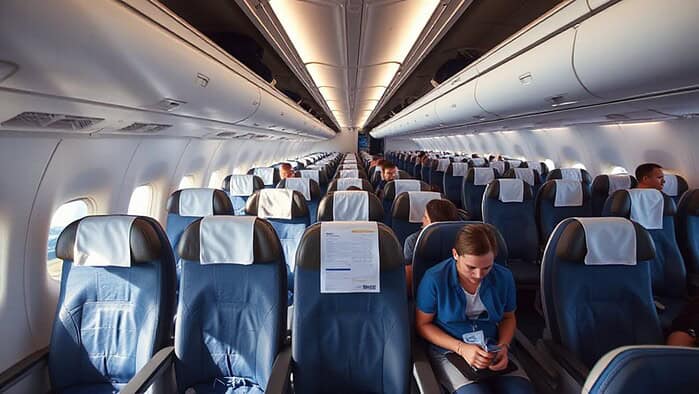
On long‑haul routes you’ll notice economy seats offering about 30‑34 inches of pitch, premium economy expanding that to 34‑42 inches, and business class stretching to 60‑80 inches with a lie‑flat option.
Seat width follows a similar pattern, with economy typically 17‑18.5 inches, premium economy 18‑20 inches, and business class 20‑22 inches or more.
Recline also jumps from a modest 2‑4 inches in economy, to 6‑9 inches in premium economy, up to a full 180° flat bed in business class.
You’ll get the most realistic sense of comfort by focusing on inner armrest width, since it better reflects the usable hip space than measurements that include part or all of the armrests.
Pitch Comparison
In long‑haul cabins, seat pitch and recline differ dramatically across classes, shaping how much space you actually get.
Economy offers 28‑34 inches, often 30‑31 inches domestically, with only 2‑4 inches of recline at a shallow angle.
Premium economy expands to 34‑42 inches and 6‑9 inches recline, while business class stretches 55‑80 inches, providing flat‑lay beds that lie fully reclined for unrestricted leg extension.
Seat Width Differences
Seat width is the next key factor that determines how comfortable a long‑haul flight feels, and it varies noticeably across economy, premium economy, and business class.
Economy seats stay around 17‑18 inches (43‑51 cm).
Premium economy expands to 18‑20 inches (45‑61 cm), often in 2‑4‑2 layouts.
Business class begins at 20 inches, reaching 22‑36 inches (46‑91 cm) with suites and wider configurations.
Recline Angles & Flatness
Because recline determines how much you can stretch out on a long‑haul flight, the angle and flatness of each class’s seat are key comfort factors.
Economy offers about 81 cm pitch and modest recline, often under 7 inches, limiting stretch.
Premium economy adds 8 cm, with 7‑9 inch recline and footrests.
Business varies: standard seats tilt 90‑110°, lie‑flat reach near 180° with a slight floor slope, and full‑flat suites provide a true 180° bed for excellent sleep.
Which In‑Flight Services Differ Across the Three Cabins?
You’ll notice that priority boarding and faster check‑in are standard in business class, optional in premium economy, and limited in economy. Meal service also scales up: economy offers basic snacks, premium economy adds upgraded dishes and a better amenity kit, while business class delivers multi‑course meals with fine wines and luxury items. These differences in service and amenities set each cabin apart from the others. For example, liquid restrictions still apply at security regardless of cabin, so your in‑flight beverage options start with having compliant liquids on hand.
Priority Boarding & Check‑In
Usually, you’ll notice that priority check‑in and boarding are the first tangible perks that set the three cabins apart.
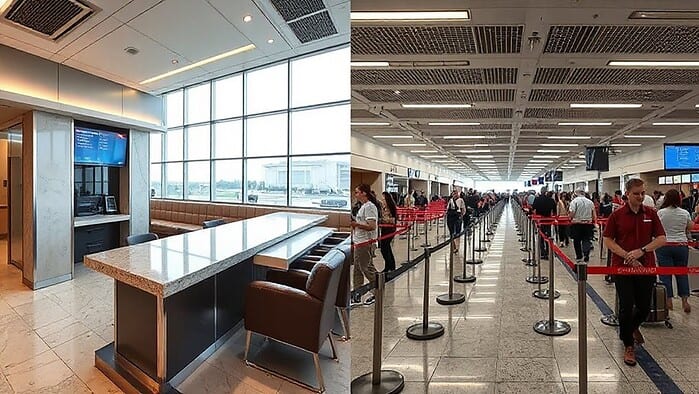
Business class skips regular lines, using dedicated check‑in counters and security lanes, and boards in Group 1.
Premium economy offers select priority check‑in and early boarding, often Group 2, on carriers like United, Delta, and Air France.
Economy passengers use standard lines and board last, without any priority access.
Meal Service & Amenities
After skipping the dedicated check‑in counters and early‑boarding groups, the next visible difference among the cabins is what you eat and drink in the air.
Business greets you with bubbly, unlimited premium drinks, three‑course meals, separate courses, and silverware.
Premium economy serves upgraded, pre‑ordered dishes on a single tray, limited complimentary drinks.
Economy offers two basic meals, only wine/beer/soda free, and a single‑serve tray.
What Baggage Limits and Lounge Perks Do You Get in Each Cabin?
If you’re flying economy, you’ll typically get one checked bag up to 23 kg (50 lb), though some routes allow a second piece.
While premium economy upgrades you to two bags of the same weight limit and business class bumps the allowance to two bags up to 32 kg (70 lb) each.
Economy carry‑on stays 56 × 45 × 25 cm, personal item 40 × 30 × 15 cm.
Premium economy enjoys the same dimensions but often gets dedicated bin space.
Business class adds priority bin access, no weight limits on carry‑ons, and complimentary lounge entry.
On Delta, carry‑on enforcement is based on the 22 x 14 x 9 rule (including wheels and handles), and gate agents may check oversized bags during peak times.
Is Premium Economy Worth the Upgrade?
What makes premium economy a worthwhile upgrade hinges on the balance between added comfort and the extra cost.
You gain 10‑20 cm more legroom, wider seats, and a deeper recline, plus a 2‑4‑2 layout that feels less crowded. Priority boarding, better meals, power outlets, and larger screens add convenience. At roughly half business‑class price, the upgrade delivers noticeable comfort without breaking your budget.
For families traveling with infants, the extra space can also make it easier to manage cabin logistics like storing a compact diaper bag and keeping essentials within reach during the flight snug harness fit.
Is Business Class Worth the Extra Cost Compared to Premium Economy?
When you compare business class to premium economy, the first thing you’ll notice is the price gap: business seats typically cost about twice as much as premium‑economy tickets, though on some routes competitive pricing can narrow that difference.
Business offers flat beds, mini‑suites, lounge entry, and higher baggage allowance, while premium economy provides extra legroom, decent meals, and priority boarding at roughly half the cost.
Choose based on how much privacy, comfort, and amenities you value for long‑haul freedom.
How to Choose the Right Cabin for Your Travel Goals?
Because your travel goals dictate how much comfort, cost, and convenience you need, you should start by evaluating budget constraints, flight duration, and personal comfort requirements before picking a cabin.
Compare economy’s $500‑800 round‑trip to premium economy’s $1,100‑1,600 and business’s $2,600+ on Europe‑US routes.
For long haul, business’s flat beds and lounge access may justify the premium; for shorter trips, premium economy’s extra legroom and upgraded meals often balance cost and comfort.
Choose the class that aligns with your budget, flight length, and desired amenities, and keep in mind that tray height strongly affects neck posture and sustained muscle tension because lower trays can force forward leaning.
And Finally
Choosing the right cabin hinges on your budget, comfort needs, and travel priorities. Economy offers the lowest fare but limited space and amenities. Premium economy adds extra legroom, better meals, and modest baggage allowances for a modest price increase. Business class delivers spacious seats, premium service, and extensive lounge access, but at a notably higher cost. We your trip’s length, required comfort, and willingness to pay, match the cabin that best aligns with those factors.