A fuel surcharge is a variable fee added to your airline ticket’s base fare, shown as a separate line item and calculated per segment based on a jet‑fuel price index. It reflects current fuel costs, carrier‑specific policies, and can be a fixed amount, a per‑kilogram charge, or a percentage of the fare. The surcharge helps airlines offset volatile jet‑fuel expenses while keeping base fares stable, and it appears on both cash and award tickets. Keep reading to learn how it’s measured and how you can manage it.
TLDR
- Fuel surcharge is a separate fee added to the base fare, calculated as a percentage of fare or a fixed amount per segment.
- It reflects volatile jet‑fuel costs, typically tied to a fuel index (e.g., U.S. Gulf Coast) and applied when prices exceed a baseline.
- The surcharge appears as a distinct line item (often labeled YQ/YR) on both cash and award tickets.
- Rates are updated weekly or monthly, varying by carrier, region, and aircraft type, and can differ for economy versus premium cabins.
- Passengers can reduce or avoid the fee by selecting airlines or frequent‑flyer programs that waive fuel surcharges or by booking through partner carriers.
What Exactly Is a Fuel Surcharge on an Airline Ticket?

When you see a fuel surcharge on an airline ticket, it’s a variable fee that airlines add to the base fare to offset the cost of jet fuel, which can swing dramatically. You’ll find it listed as a separate line item, often calculated as a percentage of the fare or based on a fuel‑price index. It appears on cash and award tickets, varies by carrier, and reflects aircraft type, distance, and current jet‑fuel prices. Fuel surcharges are typically updated weekly based on the latest jet fuel price data. These charges are one of the additional price components airlines layer on top of the base fare.
Why Airlines Add Fuel Surcharges: The Economics Behind Jet Fuel Costs
Fuel surcharges aren’t an arbitrary add‑on; they’re a direct response to the volatile cost of jet fuel, which makes up roughly 30 % of an airline’s operating expenses.
You see airlines keep base fares stable while adding a surcharge that mirrors price spikes, protecting profitability and allowing quick adjustments when fuel prices surge or fall.
This flexibility preserves competitive fares across high‑demand routes.
Fuel prices can change quickly, so airlines adjust surcharges in real time.
How Fuel Prices Are Measured for Airline Ticket Surcharges
You’ll see airlines tie their surcharges to a jet‑fuel index, usually the U.S. Gulf Coast benchmark, and compare the current price to a set baseline—often $2.00 per gallon—to decide if a surcharge applies. When the market price exceeds that baseline, carriers calculate a percentage add‑on based on the excess and update the rate weekly. This routine lets you know exactly how the index, threshold, and regular updates translate into the extra fee on your ticket, and it parallels how airports manage refueling rate to determine how quickly fuel can be delivered on the ground.
Jet Fuel Index Reference
How are jet‑fuel prices turned into the surcharge you see on an airline ticket? You’ll see the Platts Global Jet Fuel Index, a weighted composite of regional spot assessments. Each region’s weight mirrors its fuel demand, and the index compares current spot prices to a 2000 baseline (200 = double).
Weekly updates from IATA‑S&P reflect refinery‑gate prices, driving the surcharge you pay.
Baseline Price Threshold
When an airline sets its fuel surcharge, it first picks a baseline price that represents a “normal” cost for jet fuel—often a round figure like $2.00 per gallon, even if the market price is higher.
You then compare the current price to that baseline; any excess per gallon multiplied by the flight’s fuel usage creates the surcharge.
If the current price stays below the baseline, no surcharge applies.
This threshold lets airlines adjust fares quickly while keeping pricing transparent.
Weekly Price Updates
Each month’s fuel surcharge starts with a systematic review of jet‑fuel prices that runs from the first to the last day of the prior month, and the airline checks the data every Tuesday.
You’ll see IATA’s weekly jet‑fuel index, U.S. DOE diesel figures, and USGC benchmarks compared to baseline.
Updates post two weeks before the mid‑month effective date, ensuring your ticket reflects the latest market rates.
How Often Fuel Surcharges Change?

You’ll notice that airlines often update fuel surcharges weekly, but the exact cadence can differ by region and carrier.
Some carriers, like Cathay Pacific, have moved to bi‑weekly reviews to keep up with volatile jet‑fuel prices, while others stick to a weekly schedule.
Your fare may change as often as every few days, depending on the airline’s policy and the price swings in the market.
Fuel surcharges are designed to track changes in operating fuel costs rather than reflect rare events like fuel dumping.
Weekly Update Frequency
Airlines typically revisit fuel surcharges every one to two weeks, tracking jet‑fuel price swings in near real‑time. You’ll see updates as often as fifteen days, a cycle the CAB introduced to cut lag between actual costs and ticket prices.
Major carriers like Cathay Pacific, Hong Kong Airlines, and Korean Air announce hikes within this window, reflecting volatile markets and regulatory changes.
Regional Price Variations
While the weekly update cycle keeps you informed about overall price trends, the actual frequency of fuel‑surcharge adjustments varies sharply by region.
In Asia‑Pacific, carriers tweak surcharges almost daily, reacting to jet‑fuel spikes; Europe’s long‑haul changes appear monthly after geopolitical shocks; India rolls out phased hikes over weeks; the U.S. embeds costs, so you rarely see separate updates.
This regional rhythm dictates how often you’ll encounter new fees.
Carrier Update Policies
Because fuel prices can swing dramatically, carriers usually set a regular review cadence to keep surcharges in line with market reality.
You’ll see airlines checking rates every one to two weeks, with some, like Cathay Pacific, doing bi‑weekly reviews.
During volatile periods, they may trigger a 15‑day adjustment cycle, while others phase increases across routes to soften impact.
Common Carrier Surcharge Calculation Methods

When carriers add surcharges to a ticket, they typically use one of three calculation methods: a fixed‑amount fee (YQ/YR), a per‑kilogram charge (FSC), or a Category 12 rule that ties the surcharge to specific fare components. You’ll see flat YQ/YR fees listed separately, FSC multiplied by chargeable weight, and Category 12 amounts linked to fuel, insurance, or peak‑travel factors, each applied before taxes. real-time pricing models can also adjust how these surcharge strategies are reflected in the final fare as demand and route conditions change.
Percentage‑Based Surcharges: Applying the Rate to Your Base Fare
You’ll calculate the surcharge by multiplying your base fare by the percentage rate expressed as a decimal, so a 12.5% charge on a $25 ticket adds $3.13.
This amount is then added to the original fare, raising the total cost you pay—for example, a $100 base fare with a 19% surcharge becomes $119.
Because the percentage applies to the entire base fare, higher‑priced tickets generate larger absolute surcharges, directly impacting the overall price you see at checkout.
Calculating Percentage Amount
Typically, a percentage‑based fuel surcharge is calculated by multiplying your ticket’s base fare by the surcharge rate expressed as a decimal—for example, a 19 % surcharge means you multiply the base fare by 0.19.
You then add that result to the base fare, or to the applicable transportation charges.
Carriers reference weekly fuel indexes, so the decimal changes as market prices shift, ensuring the surcharge reflects current fuel costs.
Impact on Total Fare
Because the surcharge is a percentage of the base fare, the total price rises directly in proportion to that rate; you simply multiply the base fare by the surcharge decimal and add the result to the base amount.
In practice, a 19% fuel fee on a $100 fare adds $19, making $119.
Long‑haul routes often see surcharges equal to 50‑100% of low base fares, dramatically inflating the total cost.
Flat‑Fee or Per‑Mile Surcharges: Fixed Dollar Add‑Ons
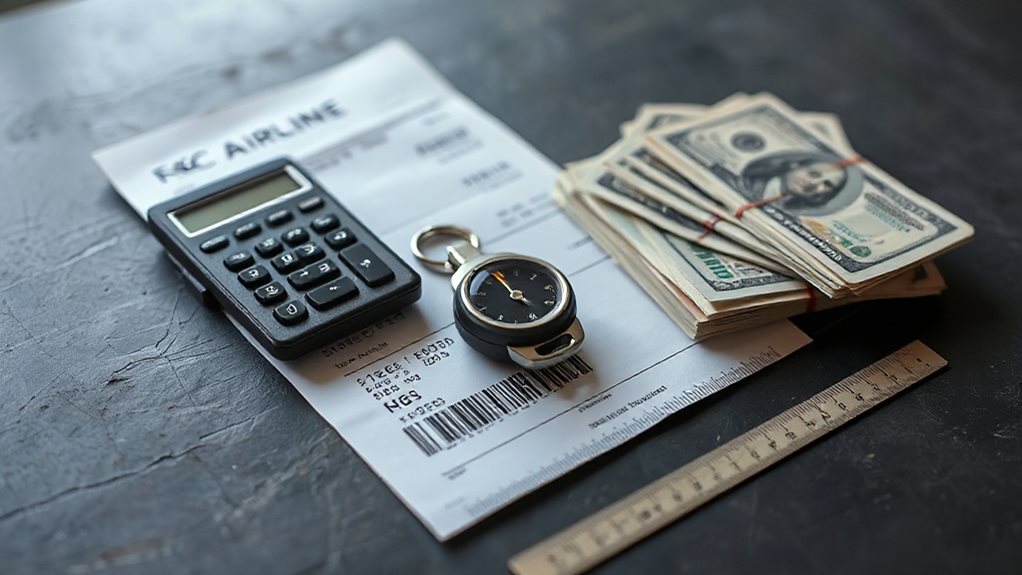
When airlines apply a flat‑fee fuel surcharge, they add a set dollar amount to each passenger’s ticket for every flight segment, regardless of how far the plane travels. You’ll see ANA charging $142 on Japan‑Europe routes, Cathay Pacific $290 short‑haul, $541 medium, $1,164 long‑haul, and Emirates $346 economy, $1,610 first/business. Fixed fees vary by carrier, class, and region, but stay constant per segment. On the operations side, fuel truck flow rate and overall refueling efficiency can influence turnaround timing even though the surcharge is charged per segment.
Cash vs. Award Ticket Surcharges: What’s Different?
If you book a cash ticket, the fuel surcharge appears automatically in the total fare, while an award ticket often requires you to pay the surcharge separately—if the airline’s frequent‑flyer program decides to pass it on.
Cash fares embed YQ/YR fees, but award bookings may demand a cash payment for those fees.
Some programs, like Lifemiles, pass none; others, like AAdvantage, pass full British Airways surcharges.
Choose carriers and programs wisely to control extra costs.
Example Calculation: Business‑Class NYC‑London Fuel Surcharge
The cash‑vs‑award surcharge discussion leads directly into a concrete illustration of how fuel fees affect a business‑class round‑trip between New York and London. On British Airways, the round‑trip fuel surcharge totals $1,900, with $932 on specific flights.
Taxes and fees add $2,068, bringing out‑of‑pocket cost to $1,039 after fees. American Airlines shows $5.60 taxes one‑way, no surcharge.
Spotting & Comparing Airline Fuel Surcharges When Booking
Because fuel surcharges are listed separately from the base fare, you can spot them quickly on any booking page. Look for YQ or YR codes under taxes and fees; they appear as distinct line items.
Compare amounts across airlines—British Airways, Lufthansa, Emirates, Air France, Iberia, SAS—using the same cabin class.
Note that first‑class fees hover around $1,700, while economy ranges from $320 to $346. This lets you gauge total cost before checkout.
How to Reduce or Eliminate Fuel Surcharges on Future Flights?

You can cut fuel surcharges by choosing award programs that simply don’t add them, by booking through partner airlines that waive the fees, and by starting your itinerary in countries where regulations keep the charges low.
Use JetBlue TrueBlue, Southwest Rapid Rewards, Spirit Free Spirit, United MileagePlus, Aeroplan, or LifeMiles for surcharge‑free awards.
Transfer points from Amex, Chase, or Citi to these programs, and position flights through Australia, Japan, or Brazil to stay clear of extra fees.
And Finally
Understanding fuel surcharges helps you see why ticket prices fluctuate and how airlines recoup volatile jet‑fuel costs. By tracking fuel‑price indices, airlines adjust surcharge rates regularly, often monthly, and apply them differently to cash and award tickets. Knowing the calculation methods lets you compare offers, spot hidden fees, and choose strategies—like flexible dates or loyalty programs—to minimize or avoid the extra charge. Stay informed, and you’ll make smarter booking decisions without surprise expenses.