
You’ll spend less with a card‑based service like Wise or Revolut because they charge about 1 % of the mid‑market rate, while airport kiosks add 5–10 % markups, hidden 1‑3 % commissions, and $5–$15 flat fees. The result is a 14–17 % premium over the IMF benchmark, often leaving you with €350–€368 from a $500 exchange versus roughly €426 via the app. If you keep reading, you’ll learn how to lock in better rates before you travel.
TLDR
- Airport kiosks typically charge a 5‑10% markup plus $5‑$15 fees, making total costs 14‑17% worse than the IMF mid‑market rate.
- Wise and Revolut use near‑mid‑market rates with fees under 1%, delivering about €426 for a $500 exchange versus €350‑€368 at kiosks.
- Banks and credit unions charge 2‑4% margins, still lower than kiosks but higher than digital apps; they may add hidden commissions.
- Card‑based conversions are cheapest when the card has 0% foreign fees and DCC is declined, keeping costs near 1% of the transaction.
- Use airport kiosks only for small, urgent cash needs (<$100) or when cards fail, otherwise digital apps or low‑fee cards save 10‑16% on the same amount.
Why Do Airport Kiosks Charge You More Than the Market Exchange Rate?
Because airport kiosks operate in a high‑traffic, high‑cost environment, they add a markup to the exchange rate that typically runs 5‑10% above the market benchmark. You see a $5‑15 fee per transaction, and a $500 exchange can cost $25‑65 more than a bank rate. The hidden spread and extra charges compound, especially for frequent travelers, eroding freedom to keep money. licensed exchanges also tend to be safer than unregulated options, which helps you avoid poor rates and counterfeit risk. U.S. dollar reporting is required for tax purposes.
How Card‑Based Services Like Wise and Revolut Stay Within 1% of Market Exchange Rates?
If you compare Wise and Revolut, you’ll see that both services keep their total conversion cost under 1 % of the market exchange rate by separating a small, transparent service fee from a near‑mid‑market rate.
Wise applies a 0.33‑0.6 % upfront fee while using the true mid‑market price, and Revolut embeds a 0‑0.5 % fee in its displayed rate, with weekend or limit surcharges staying under the same 1 % threshold.
This structure lets you travel financially free.
Real‑World Cost Comparison: $500 Exchange at Airport Exchange Rates vs. a Digital App
You’ll see the airport’s 14‑17 % premium cuts a $500 exchange down to roughly €350‑€368, while a digital app that tracks the mid‑market rate gives you about €426 with no extra fees.
The gap between the two methods translates to a net saving of €58 or around 16 % when you choose the app.
This comparison highlights the airport’s rate gap versus the clear cost advantage of the digital approach.
If you’re also packing toiletries for travel, remember the 3‑1‑1 rule to avoid delays at security.
Airport Rate Gap
When you walk into an airport kiosk with $500 to exchange, the rate you get is typically 14 % to 17 % worse than the IMF mid‑market rate, meaning you end up with roughly $70‑$85 less foreign currency than you’d at a digital app that follows the same benchmark.
Those premiums translate into a real‑world gap: a 14 % markup shaves $70, while a 17 % markup costs $85.
Even banks at 6 % still beat airport rates, so the airport line costs you both money and time.
Digital App Savings
At a typical airport kiosk, swapping $500 for foreign cash costs you roughly 14 %–17 % more than using a digital app that follows the mid‑market rate, which translates to a loss of $70–$85.
Digital apps like Wise or Revolut apply minimal fees and use real‑time rates, letting you keep most of your money.
You’ll avoid hidden commissions, enjoy transparent pricing, and preserve travel budget flexibility.
What Hidden Fees Are Buried in Airport Kiosk Signs?
When you glance at an airport kiosk sign, the advertised “0 % fee” often masks a hidden rate markup that can be 5‑10 % worse than the market, eroding the value of every transaction.
You’ll also find undisclosed transaction fees—typically 1‑3 % commissions or flat service charges that aren’t listed on the sign but appear in the final amount you receive.
Together, these hidden costs can add up quickly, turning a seemingly simple exchange into a surprisingly expensive one.
Hidden Rate Markup
Spot the hidden cost on the airport kiosk sign: the rate they display already includes a 5‑10 % markup over the mid‑market exchange rate, and the sign never tells you how much worse it’s compared to the true market price.
You end up paying $25‑$50 extra on a $500 exchange, and the markup compounds on larger sums, eroding your travel budget without any clear disclosure.
Undisclosed Transaction Fees
If you glance at an airport kiosk sign, the displayed exchange rate is only part of the story; the real cost often hides behind a series of undisclosed transaction fees.
You’ll face commissions up to three percent, flat service charges of five to fifteen dollars, and extra small‑transaction fees that only appear in fine print.
These hidden costs quickly add up, especially on larger exchanges, eroding the freedom you expect from a simple currency swap.
Bank vs. Credit‑Union Exchange Margins vs Airport Rates
Even though banks and credit unions both pull their rates from the same daily forex market, their margins differ enough to affect your wallet.
Banks charge 2.5‑4 % on major currencies, costing $25‑$40 per $1,000, while credit unions sit at 2‑3.5 %, $20‑$35.
Airport kiosks jump to 5‑10 %, $50‑$100.
The extra spread and occasional fees make banks and unions noticeably cheaper than airport services.
Since the U.S. dollar is the official currency in St. Thomas, you’ll usually avoid currency-exchange markups altogether by paying in USD.
How to Calculate Total Exchange Costs for Frequent Business Travelers
How can you accurately gauge the total cost of currency exchange when you travel for business month after month? Start by logging each transaction, noting the amount, date, and the rate you received.
Apply the airport formula (unfavorable rate + percentage fee + fixed charge) and the card formula (mid‑market rate + issuer fee). Sum the results across trips, then compare the cumulative totals to reveal your true expense, since low season savings on hotels and travel costs can also shift your effective budget.
Tips to Lock in Better Airport Exchange Rates Before You Leave the House
You can pre‑book online rates through your bank or a reputable currency service, which locks in a better price before you even step out the door.
Setting up travel‑specific alerts lets you monitor market shifts and act when the rate hits your target.
Combining these tactics gives you control over costs and reduces reliance on costly airport counters.
Pre‑Book Online Rates
When you lock in a rate online before you leave home, you sidestep the 14‑17 % premiums that airport counters typically add to IMF benchmarks.
Pre‑booked orders let you pick a provider—CXI, Bank of America, or LA Currency—compare real‑time rates, and reserve the exact amount you need.
Fees stay low, often under $10, and you collect cash at airport branches, avoiding queues and last‑minute ATM costs.
This strategy preserves freedom and cuts expenses.
Set Up Travel‑Specific Alerts
Setting up travel‑specific exchange‑rate alerts lets you monitor market movements without constantly checking charts, and the process is simple enough to complete in a few minutes before you leave home.
Create a free account on platforms like Xe, Wise, or OFX, pick your currency pairs, set target mid‑market rates, and choose email or SMS notifications.
Alerts trigger automatically, giving you the freedom to act when rates hit your thresholds.
Prepaid Travel Cards: A Low‑Cost Alternative to Airport Exchange Premiums
If you lock in the exchange rate when you purchase a prepaid travel card, you eliminate the uncertainty of currency fluctuations during your trip. You also avoid the common roaming-style “rip‑off” pricing by using the same approach that prevents exchange surprises for instant savings while abroad. You load the exact amount you need, avoid 8‑10 % airport mark‑ups, and pay no conversion fees on many cards. Reloadable, multi‑currency cards keep your budget stable, protect against loss, and let you withdraw cash worldwide without surprise costs.
When Does an Airport Kiosk Make Financial Sense?
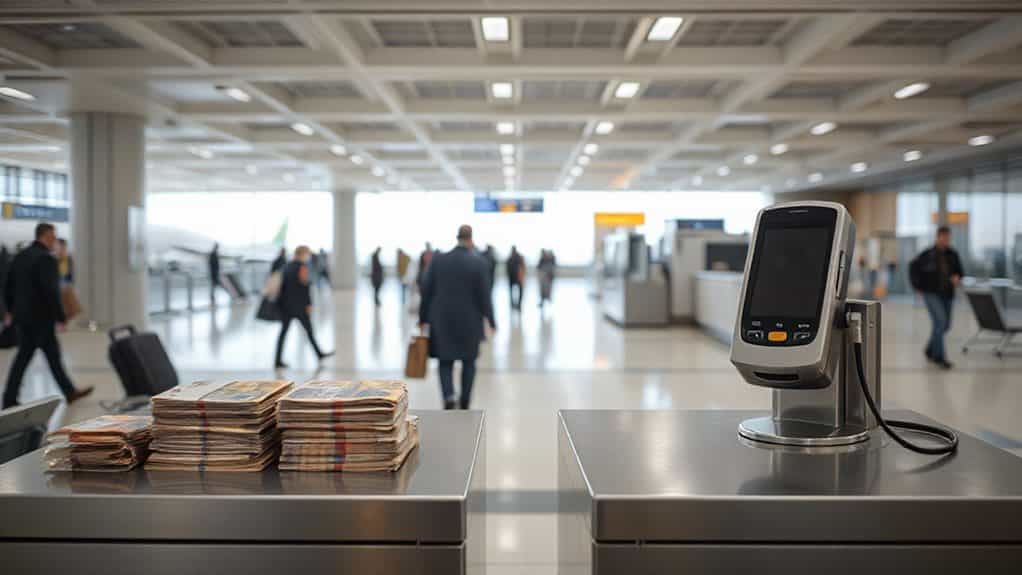
Even if airport kiosks typically charge 5‑10 % above market rates and tack on $5‑$15 fees per transaction, they can still make financial sense in a few specific situations. You’ll benefit when you need under $100 cash for a taxi or tip, when cards fail and no ATMs exist, or during a layover under an hour where speed matters. Skip line delays also sometimes justifies the kiosk premium when time constraints prevent you from shopping around for better rates. Small, urgent, or emergency purchases justify the premium.
Which Exchange Method Is Cheapest for Your Trip? A Quick Decision Checklist
Which method saves you the most money depends on three core factors: the total amount you’ll spend, the fees your cards charge, and the exchange rate you’ll receive.
If your card has 0% foreign fees, use it and decline DCC for about 1% processor cost.
For larger budgets, compare airport kiosk rates and commissions; they usually exceed 3‑6% total.
Check ATM fees and local bank rates before deciding.
And Finally
In the end, airport kiosks typically charge a hefty premium, often 5‑10 % above market rates, while digital services like Wise or Revolut keep fees under 1 %. Prepaid travel cards and bank exchanges can be cheaper, but they still lag behind online apps. If you lock in a rate before you travel, you’ll save the most. Use the checklist to match your needs with the lowest‑cost option and avoid unnecessary fees.