When you check in, the airline sticks a RAIN RFID‑enabled EBT tag on your bag and programs it with a unique ID and flight data. The tag’s ID is captured at four IATA‑mandated RFID checkpoints—check‑in, transfer, loading, and final gate—creating a secure audit trail. Automated tag‑reading systems fill any read gaps at conveyor intersections or security points, while edge AI fuses RFID, laser, and vision data. Cloud analytics then turn these pings into real‑time alerts that flag delays or misrouted bags, and if you keep going you’ll uncover more details.
TLDR
- RFID tags are programmed with a unique ID and flight data, then attached to bags at check‑in, where readers capture the ID and link it to the boarding barcode.
- IATA‑mandated tracking logs each bag at four core points: audit check‑in, transfer verification, loading, and final claim, creating a secure audit trail.
- Checkpoint RFID readers record the bag’s ID, location, and timestamp in real time, updating airline systems as bags move through conveyors, portals, and loading zones.
- Hybrid Automated Tag Reading (ATR) systems combine RFID, laser, and computer‑vision sensors to fill coverage gaps at critical hand‑off points, ensuring continuous tracking.
- Edge AI and cloud analytics fuse sensor pings with flight, weather, and historic data to detect anomalies, assign loss probabilities, and generate predictive alerts for rerouting and resource allocation.
Kick‑Off the Baggage Journey With RAIN RFID & EBT Tags

When you check your bag, the trip kicks off the moment a RAIN RFID‑enabled EBT tag is attached. The tag, programmed during printing, stores a unique identifier and flight data. Airport readers instantly capture this ID at check‑in, linking it to your boarding barcode. Simultaneous, non‑line‑of‑sight reads keep you informed via app or SMS, reducing mishandling and speeding reconciliation. This system can read up to a thousand items per second, enabling high‑speed identification throughout the baggage handling process. Because the RFID tag can be scanned reliably in carry‑on or checked baggage operations, teams can more easily ensure the right item stays with your itinerary during transfers while also keeping safety-critical items like lithium batteries compliant with carry‑on rules.
Why IATA’s Four Core RFID Baggage Tracking Points Matter
You’ll see that the audit check‑in validation creates a secure baseline for every bag the moment you hand it over, recording its tag, flight, and time automatically.
When the bag reaches a transfer point, the system confirms its exact location and makes certain it’s routed to the right connecting flight, preventing missed connections.
Together, these two points give airlines real‑time visibility and a solid audit trail that reduces mishandling and improves passenger confidence—especially when you need to file a Property Irregularity Report after reporting a missing bag immediately.
Audit Check‑In Validation
Because IATA Resolution 753 mandates that every piece of baggage be logged at four distinct points, the check‑in validation step becomes the foundation for a reliable tracking chain.
At check‑in you hand your bag to staff, who scan the RFID tag or barcode, record the bag tag, flight, time, and container ID in the Baggage Record System.
This instant capture creates a verifiable audit point, ensuring your luggage is tracked from the moment you drop it off.
Transfer Point Confirmation
If you’re connecting flights, the transfer point confirmation is the third pillar of IATA’s four‑core RFID tracking system, capturing the bag’s tag number and exact location as it moves from one aircraft to the next.
Handheld scanners or fixed readers log the tag, flight numbers, station, and time, creating a verifiable audit trail.
This real‑time data lets airlines and interline partners confirm handover, reduce mishandling, and keep your luggage on schedule.
Track a Bag Across Each Check‑point RFID Reader
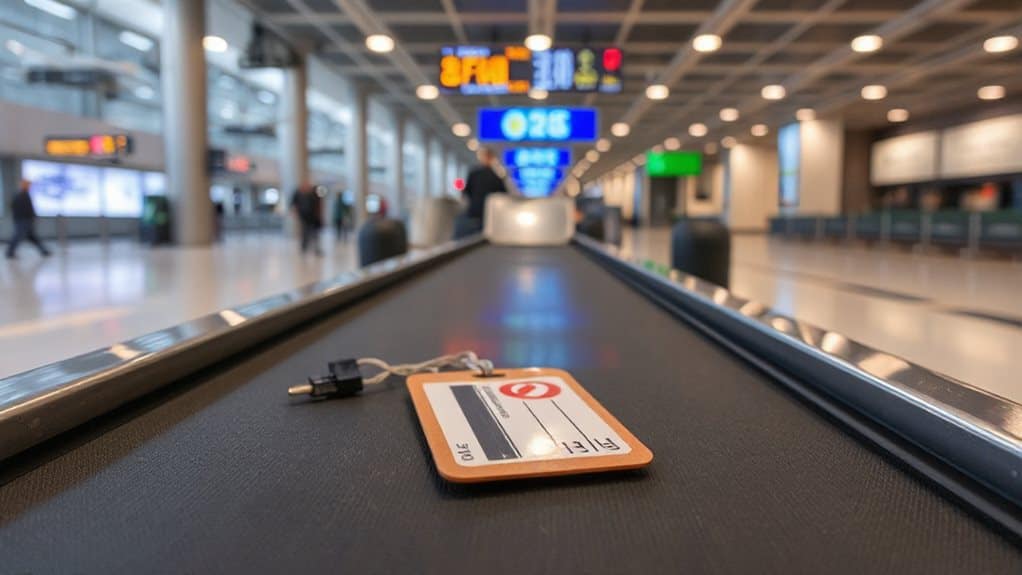
When a bag passes a checkpoint, the RFID reader instantly captures the tag’s signal and logs the bag’s unique ID, location, and timestamp.
You then see that data flow to the airline’s system, updating in real time as the bag moves through conveyor belts, transfer portals, and loading zones.
Each reader records a precise moment, creating a continuous, searchable trail that guarantees you know exactly where your luggage is at any stage.
Fill RFID Gaps With Automated Tag Reading (ATR)
You’ll notice that hybrid ATR systems extend coverage zones, so bags that slip past RFID readers still get identified by laser or camera sensors.
By bridging critical transfer points—like conveyor intersections and security checkpoints—the technology guarantees continuous tracking without gaps.
This layered approach enhances read rates and reduces manual handling, keeping luggage moving smoothly through the airport.
Hybrid Enhancing Coverage Zones
Because traditional RFID readers often miss bags at busy transfer points, integrating Automated Tag Reading (ATR) fills those gaps and creates a seamless coverage zone.
You’ll see hybrid sensor arrays—laser, camera, and RFID—working together to monitor every handoff.
Edge AI analyzes data in real time, spotting delays and rerouting bags before they become problems.
The system aligns with IATA Resolution 753, providing consistent, end‑to‑end visibility and freeing you from missed‑connection worries.
Bridging Critical Transfer Points
If you focus on the most congested hand‑off zones—pier, transfer, and claim areas—automated tag reading (ATR) instantly plugs the RFID blind spots that traditionally cause tracking gaps.
ATR uses laser, camera, and RFID sensors to read tags without line‑of‑sight, producing 99.9% success across drop‑off, conveyor, and carousel points.
Real‑time reads keep your bag’s trip visible, cutting errors and freeing you from lost‑luggage worries.
Turn Reader Pings Into Real‑Time Predictive Alerts

How do reader pings become real‑time predictive alerts? You feed RFID, computer‑vision, and laser data into edge AI that tags each bag’s location.
Cloud analytics merge those pings with historical flow, weather, and flight data.
Machine‑learning models spot anomalies—missed connections, congestion, routing errors—and assign loss probabilities.
Alerts surface on dashboards, priority‑sorted by connection timing and bottlenecks, prompting staff to reroute or allocate resources before disruption hits.
Savings & Customer Benefits of End‑to‑End RFID Baggage Tracking
When airlines adopt end‑to‑end RFID baggage tracking, they cut mishandling rates dramatically and open sizable cost savings.
You’ll see global mishandling costs drop, labor expenses shrink by $0.10‑$0.15 per bag, and IATA projects $5 billion savings by 2026.
Processing speeds rise 40 %, claim wait times fall to twelve minutes, and real‑time tracking gives you freedom from luggage anxiety.
This also helps counter baggage fee dodging behaviors by improving accountability for each checked item through the journey.
And Finally
You now see how RAIN RFID and EBT tags start the bag’s voyage, why IATA’s four RFID points are critical, and how each reader ping creates a continuous, real‑time image. Automated tag reading fills gaps, while predictive alerts flag issues before they become problems. The result is faster, more reliable handling, lower operational costs, and a smoother experience for passengers. End‑to‑end RFID tracking delivers measurable savings and measurable service improvements.