You fly at night by adapting your eyes to darkness, using red or dim blue cockpit lights to preserve night vision. You scan with peripheral vision and rely on instruments like VOR and radar when outside cues fade. Night vision goggles and infrared systems enhance visibility, while proper runway lighting helps identify approach paths. Modern tech like synthetic vision and EFVS improves safety, letting you operate effectively even in near-total darkness—there’s more to how these systems work together than meets the eye.
TLDR
- Pilots rely on instrument flying (IFR) when natural visual cues like the horizon are unavailable at night.
- Cockpit and runway lighting are adjusted to preserve night vision and ensure clear visibility during takeoff and landing.
- Night vision goggles (NVGs) amplify ambient light to enhance terrain and obstacle detection in darkness.
- Scanning with peripheral vision and using short eye movements improve object recognition in low-light conditions.
- Advanced systems like EFVS and synthetic vision provide real-time, 3D terrain displays to aid navigation and safety at night.
How Do Pilots See in the Dark?
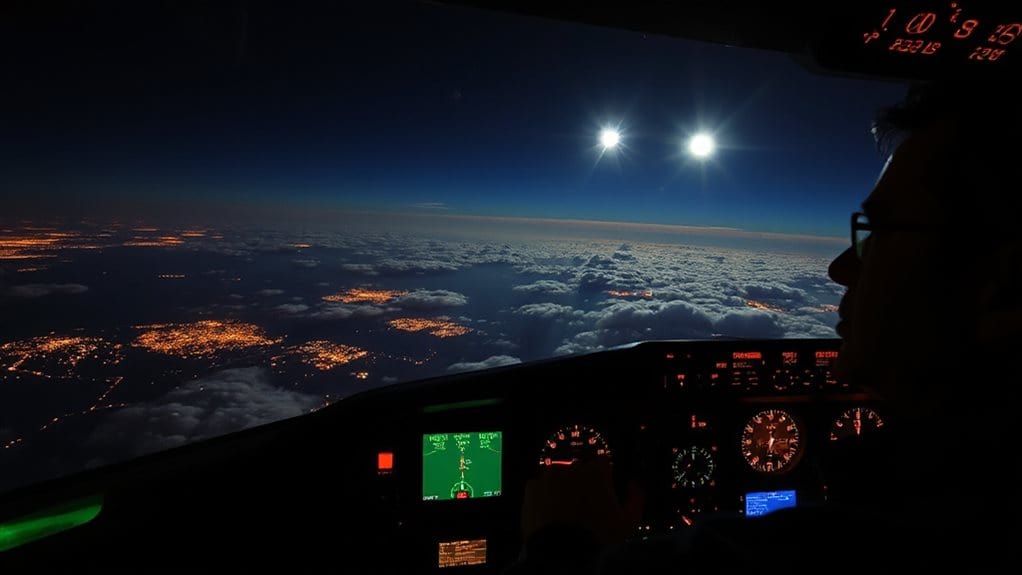
How do you see clearly when the world outside your cockpit is pitch black? Your eyes need up to 30 minutes to adapt, relying on rhodopsin regeneration in rods for low-light vision.
Use red or dim blue cockpit lights to preserve night vision, avoid white light, and scan with peripheral vision. Short, 10-degree movements, held for one second, enhance object detection. Many pilots choose to cruise at higher flight levels to reduce external lighting and atmospheric disturbances, often operating between 41,000–51,000 feet when aircraft capability and conditions allow.
Enhanced situational awareness comes from integrating instrument scans with visual scanning, especially when external cues are limited at night.
Night Vision Goggles and Infrared Camera Systems
Night vision goggles (NVGs) give you a critical edge when flying in darkness, turning faint traces of ambient light into a usable visual field.
You rely on image intensifier tubes, like those in ANVIS-9 systems, to enhance visibility and maintain situational awareness.
NVGs improve safety by revealing terrain and obstacles, though they limit peripheral vision and increase workload.
Advanced models, such as the GPNVG-18, offer a wider 97° field of view, enhancing your operational freedom during night missions.
Pilots must also be aware of color vision requirements because accurate color perception affects the interpretation of lighting and cockpit signals.
How Instruments Guide Pilots When Visibility Fails
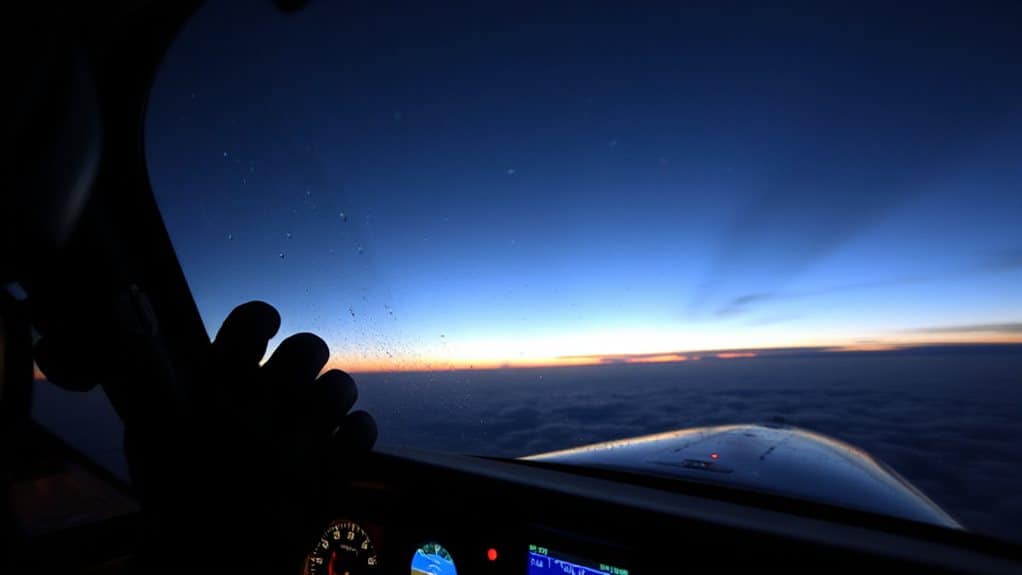
When visibility fades after sunset or drops due to weather, you can’t rely on the horizon or ground features to keep the aircraft steady—so you turn to instruments to stay oriented and on course.
You fly IFR, using VOR and NDB signals to track your position. Cockpit instruments, tuned and dimmed, give real-time guidance.
ADF needles and VOR radials keep you on path, while VASI or PAPI lights confirm your glidepath.
You stay precise, safe, and in control—no matter how dark it gets.
Modern Doppler weather radar helps pilots detect and avoid hazardous thunderstorm cells in real time, so they can maintain a safe distance of at least 20 miles from severe storms.
Cockpit and Runway Lighting for Night Operations
As you prepare for night operations, proper lighting becomes essential for both safety and situational awareness. Adjust cockpit lights with dimmer switches to reduce glare and preserve night vision.
Keep interior lighting low, especially as ambient light fades. Use pilot-controlled lighting at non-towered airports to activate runway lights and set intensity.
Recognize threshold, edge, centerline, and touchdown zone lights to identify runway layout and limits during approach and landing.
Thunderstorms and strong winds can still force cancellations or diversions during night operations, so monitor forecasts for gust fronts and other hazardous weather.
How Night Flying Has Become Safer With Technology
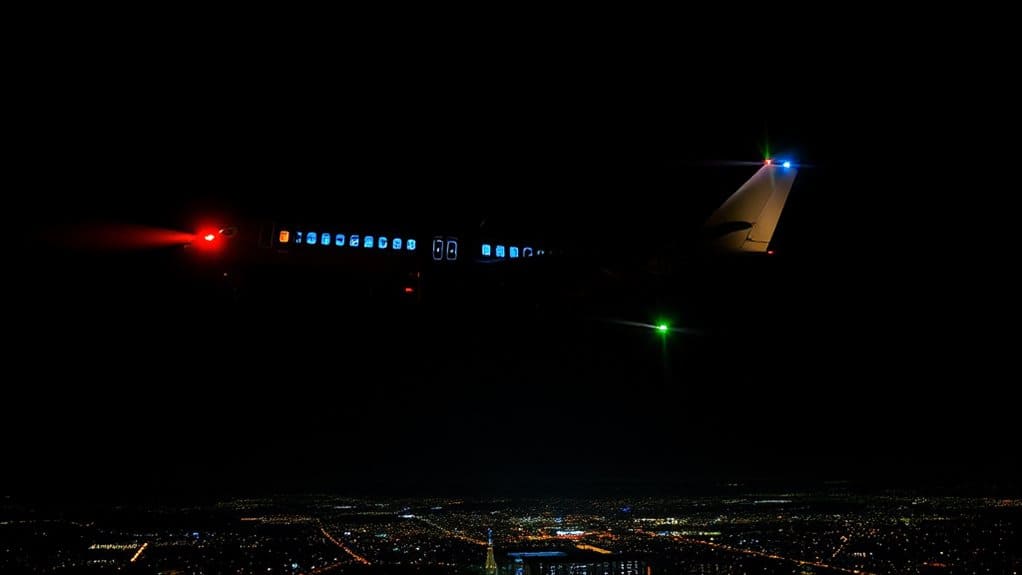
Though flying at night once relied heavily on instinct and limited visibility, modern technology now gives you a clearer, more accurate depiction of your surroundings.
SVS and HITS provide 3D terrain views, reducing CFIT risks.
EFVS delivers real-time night vision with AI-enhanced imaging.
You rely on instruments, maintain dark adaptation, and use precise ATC communication, all improving safety and control in low visibility.
Helicopter operations have become notably safer over time, with the US fatal accident rate halving over two decades and a continuing decline in accidents due to improved systems and training, including reduced fatal accidents.
And Finally
You rely on advanced tools and well-lit environments when flying at night. Night vision goggles and infrared cameras help you see outside the cockpit, while instruments guide you when visibility drops. Bright cockpit and runway lights keep critical areas visible. Technology like GPS and automated systems has made night flights safer over time. You stay alert, follow procedures, and trust the equipment, ensuring a smooth, controlled flight from takeoff to landing.