
You’ll see that airlines tag and scan every bag, then a clock starts; if it’s not on the carousel within 24 hours it’s marked delayed, after 14‑21 days it’s considered lost, and after a 90‑day search it becomes “orphaned.” The orphaned luggage is sent to a central hub—most famously Alabama’s Unclaimed Baggage Center—where it’s sorted, valued, and either auctioned, donated, or recycled. High‑value items like diamonds, watches, and even a meteorite sometimes surface. Continue for the full process.
TLDR
- Airlines flag bags as “delayed” after 24 hours, “lost” after 14‑21 days, and “orphaned” after 90 days, then move them to a central database.
- Unclaimed bags are transferred to auction houses; buyers bid on entire cases without inspecting contents, often at 80 % below retail.
- After auctions, remaining items are sorted for charitable donation, resale, or recycling at facilities like the Alabama Unclaimed Baggage Center.
- Owners must file a claim within 21 days with itemized receipts; airlines reimburse up to $3,800, then may sell the bag if unclaimed.
- The inspection process can uncover high‑value items—jewelry, watches, rare artifacts—while unusable materials are recycled to reduce landfill waste.
Why Bags End Up Unclaimed: Overview of Mishandling and Orphaning
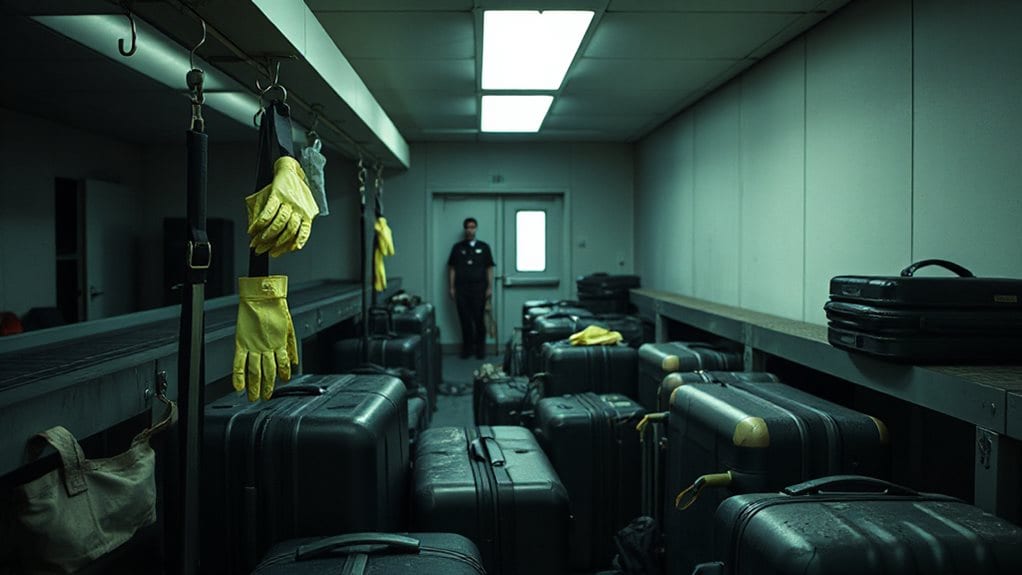
When bags go missing, it’s usually because they’re mishandled or orphaned during the complex trip from check‑in to the carousel.
You’ll see 33.4 million mishandled bags worldwide in 2024, about 6.3 per 1,000 passengers, with transfers causing 41 % of cases.
International flights suffer five times higher rates than domestic, and carriers like Air India and Frontier lead in loss percentages. Air India ranks 1 in 84 (1.19 %) for lost luggage, the highest among airlines. Most issues resolve within 48 hours, but a fraction remain lost or damaged.
After you report the loss, file a Property Irregularity Report (PIR) so the airline can track your claim.
How Airlines Identify Unclaimed Baggage
You’ll see that every time a bag passes a checkpoint, its tag is scanned and logged, creating a trail of data the airline can follow.
If a piece of luggage hasn’t been located after a set period, the system flags it based on time, then cross‑references all the scanned entries in a centralized database to match it with any outstanding reports.
This combination of tag scans, time‑based flagging, and data matching lets the airline pinpoint unclaimed bags quickly and move them toward resolution.
Similarly, once staff locate a found item, hotels document it within 2 hours to keep tracking accurate and accountable.
Tracking Tag Scans
In the world of baggage handling, airlines rely on the WorldTracer system to turn a simple claim tag into a powerful tracking tool.
You scan the tag’s barcode at the desk, generating a PIR number that feeds into the global database.
Each subsequent scan matches the bag’s routing data, linking it to your report.
Consumer trackers can add temporary links, enhancing accuracy while protecting privacy.
This automation speeds recovery and cuts manual errors.
Time‑Based Flagging
After a bag’s barcode is scanned, airlines start a clock that determines when the piece becomes “unclaimed.” If the luggage hasn’t appeared on the carousel within 24 hours, the system flags it as delayed, and a DOT‑required complaint can be filed.
After 24 hours you get a delayed alert; after 14‑21 days you’re marked lost.
At busy hubs a 30‑45‑minute wait triggers the flag, while Delta or Alaska use a 20‑minute guarantee.
The clock keeps ticking toward a 90‑day holding period before the bag is classified as orphaned and eventually sold in bulk.
Centralized Data Matching
When the 24‑hour clock expires, airlines turn to a centralized matching system to locate the unclaimed bag. You’ll see WorldTracer aggregating barcode data, flight numbers, and passenger names from every carrier.
The software cross‑checks inventory lists and detailed claim forms, linking bag contents to your description.
Real‑time tags like AirTag can supplement the database, enhancing the chance of reunification before the 90‑day deadline.
International vs. Domestic: Why Foreign Flights Lose More Baggage
Because international flights involve far more complex routing and hand‑offs than domestic trips, they’re five times more likely to lose luggage. You’ll see higher mishandling rates at busy hubs like Paris Charles de Gaulle, where multiple transfers and partner airlines create gaps.
Domestic flights, by contrast, have lower rates—about 0.58%—and fewer hand‑offs, keeping losses far less frequent.
What Happens During the 90‑Day Unclaimed Baggage Search?
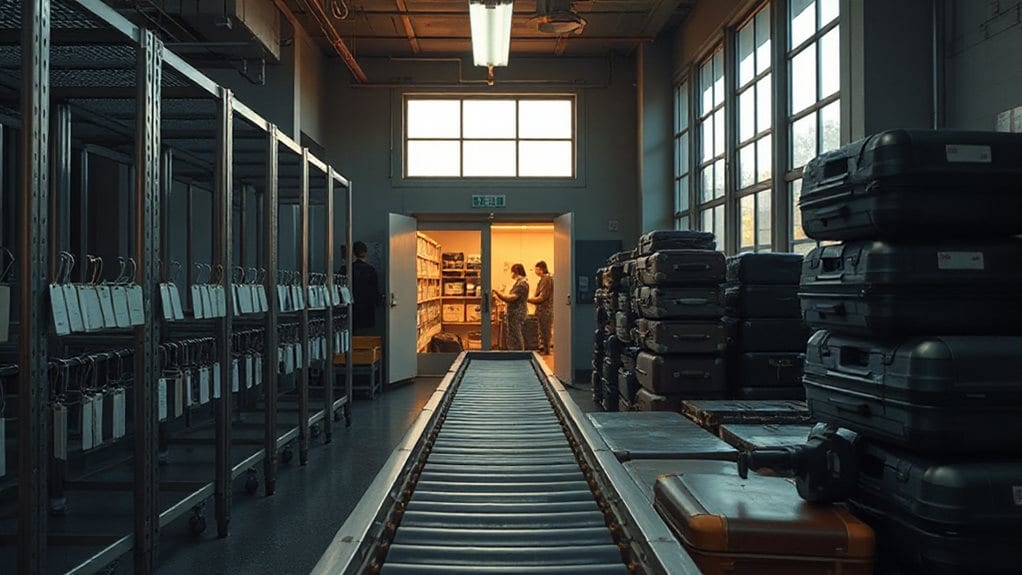
You’ll see the bag’s barcode scanned at each checkpoint, letting the airline trace its last known location and match it to your reservation details.
Airport staff coordinate with the carrier’s tracking software and the WorldTracer system, updating inventory and contacting you if they find a match.
After 90 days of this systematic search, the airline decides whether to keep the bag for you, issue a claim, or transfer it to the unclaimed-baggage salvage program.
Before that final decision, the search process may also use USDA-endorsed health certificate records and related documentation when applicable.
Initial Bag Tracking
Although a bag may seem lost at first, airlines immediately launch a coordinated tracking process that lasts up to 90 days.
You receive a Property Irregularity Report with a 10‑character reference number, then the system scans WorldTracer and RFID data across airports.
Barcode and routing info feed automated searches, while staff at each stop systematically look for your luggage, updating status through portals or hotlines.
Airport Personnel Coordination
Coordinate with airport staff as soon as your bag is reported missing, and you’ll see a systematic, multi‑airport search unfold over the next 90 days.
You’ll learn each stop checks baggage logs, scans barcodes, and runs software matches against your claim.
Staff use automated sorters, real‑time trackers, and regular status updates, while you follow up with the tracking number to keep the search moving.
Final Disposition Determination
When the 90‑day window opens, the airline moves the bag from the terminal’s short‑term hold to a central warehouse where it stays for the remainder of the search period.
You’ll see barcode stickers and WorldTracer data guiding staff as they inventory contents and match claims.
If no owner appears, after ninety days the bag is sold to a salvage center, repurposed, or recycled, freeing space for new luggage.
Where Do Orphaned Bags End Up? Inside Alabama’s Unclaimed Baggage Facility
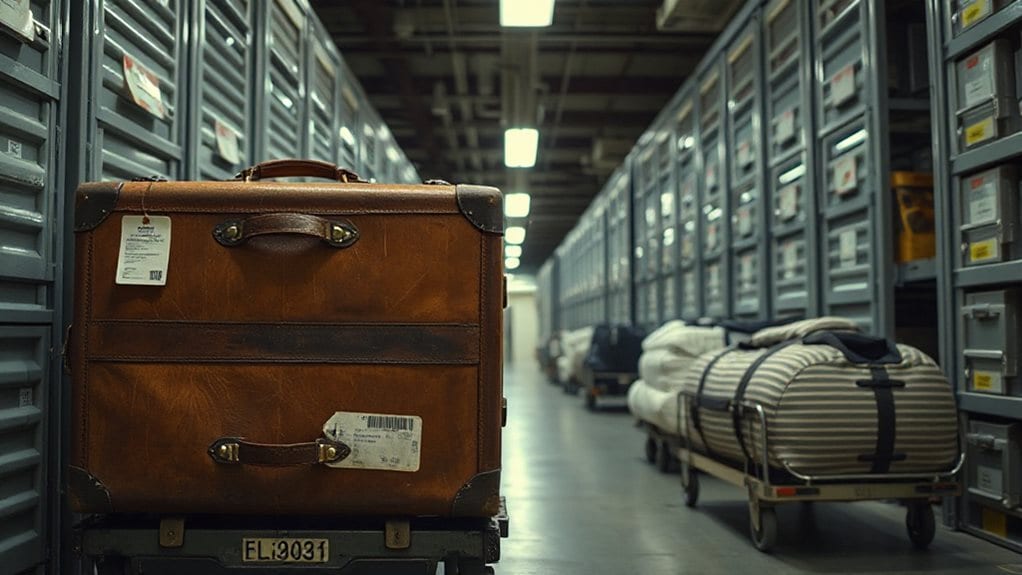
Inside the sprawling 540,000‑square‑foot Unclaimed Baggage Center in Scottsboro, Alabama, orphaned bags from airlines, trains, buses and even amusement parks are sorted, cleaned and either sold, donated or recycled. You’ll see roughly 7,000 items daily, a third sold, a third donated, and a third discarded. Items travel from planes, trains, buses, and amusement parks, then pass through Alabama‑owned laundry and processing before reaching shelves or charities. Unclaimed items include checked boxes that met size requirements and were screened through TSA before being lost or not claimed.
How Airlines Calculate the $3,800 Unclaimed Baggage Reimbursement
Airlines arrive the $3,800 reimbursement by first determining whether a bag qualifies as lost under DOT rules, then applying a depreciation schedule to the declared value of its contents.
You file a PIR, submit itemized receipts, and claim within 21 days.
The airline calculates depreciated values—e.g., a $2,500 bag drops to $1,760—checks against the $3,800 cap, and refunds bag fees automatically within weeks.
Sorting, Valuing, and Cataloguing Unclaimed Baggage Items

The $3,800 reimbursement process ends once the airline confirms a bag meets DOT loss criteria, but the work doesn’t stop there; the next step is sorting, valuing, and cataloguing the unclaimed items.
You watch employees scan each suitcase, flag hazardous goods, then separate contents into sell, donate, or recycle piles.
They assess cleanliness, market value, and rarity, logging every piece in WorldTracer and inventory databases before moving items to storage or salvage.
Once the items are cleared under safety and eligibility rules, airlines apply consistent standards for equal handling and documentation regardless of who the baggage crew is, reflecting gender-neutral workplace policies.
Selling or Donating Unclaimed Baggage Items
You’ll see that auction processes let airlines monetize high‑value items quickly, with bids posted online and winners notified within days, while charitable distribution strategies channel a portion of the inventory to nonprofits that match items to people in need, ensuring compliance with privacy rules and maximizing community benefit.
Auction Processes
When an airline’s three‑month holding period ends, the suitcase is transferred to an auction house where the bidding process begins.
You’ll see in‑person or online auctions where buyers can’t inspect contents before bidding.
The highest bidder claims the entire case, often at up to 80 % below retail.
Auctions like Mulberry Bank’s bi‑monthly sales and BCVA’s online events ship worldwide, ensuring reuse over discard.
Charitable Distribution Strategies
After the auction phase, airlines shift focus to charitable distribution, handling the remaining unclaimed baggage through both sales and donations.
You’ll see bags sold to Unclaimed Baggage after owners receive up to $4,700, then sorted for retail or disposal.
Partner groups like Lions Club receive glasses, Wheels for the World gets mobility aids, and Love Luggage delivers painted suitcases to nurture children, turning abandoned items into useful resources.
Recycling or Disposing Unusable Baggage Materials
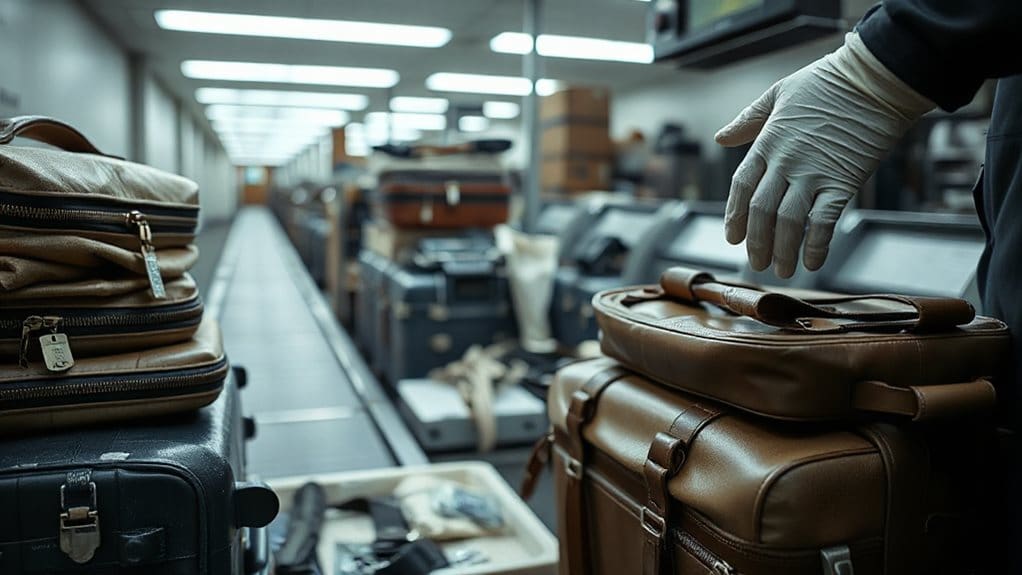
Usually, the process for handling unusable baggage materials begins with a thorough inspection at the Unclaimed Baggage complex in Scottsboro, Alabama, where employees quickly determine whether each item can be cleaned, resold, donated, or sent to recycling.
After sorting, unsuitable suitcases move to recycling streams, where metal frames, plastic shells, and fabric liners are broken down.
This diverts millions of items from landfills, aligning with the airline’s sustainability goals.
Adding one more important detail, electronic interference is one reason airlines enforce safe, standardized procedures during travel.
Unexpected Items Discovered in Unclaimed Baggage
The inspection process that separates usable from unusable baggage often reveals items far beyond ordinary luggage, and the unclaimed baggage complex in Scottsboro, Alabama, regularly uncovers a surprising assortment of objects. You’ll find white diamond earrings, gold‑diamond grills, a $37k ring, a Rolex, samurai swords, a bayonet, a meteorite fragment, a bionic knee, a robot, a frog‑shaped purse, and even a sack of rat poison, all catalogued for possible resale or disposal.
And Finally
You’ve learned that unclaimed luggage isn’t simply discarded; airlines track it, hold it for 90 days, then move it to a central facility—often in Alabama—where it’s sorted, valued, and either sold, donated, or recycled. International flights tend to lose more bags, but the process remains the same: inventory, assessment, and disposition. Ultimately, the system turns forgotten items into usable resources while complying with regulations and minimizing waste.