
You’ll see that airport gate assignments balance passenger convenience with airline efficiency. Planners match aircraft size to gate dimensions, avoid adjacent large‑aircraft conflicts, and respect safety‑designated origins while ground handlers dictate which gates can service a flight. Real‑time data from AODB, FIDS, and surveillance feeds trigger dynamic re‑planning when flights arrive early or are delayed, using integer programming or deep‑reinforcement models that run in seconds. Passenger walk distances are minimized by ranking gates with PAX‑DIST and placing high‑volume connections nearby, and performance is tracked through conflict frequency, taxi‑out delays, and on‑time departure metrics. Continue for deeper understanding.
TLDR
- Airlines match each aircraft’s size and service requirements to compatible gates, respecting safety and ground‑handler constraints.
- Gate assignments prioritize minimizing passenger walking distances, especially for high‑volume connections, using metrics like PAX‑DIST.
- Real‑time disruptions trigger dynamic re‑planning; integer programming or reinforcement‑learning models reassign gates within seconds while honoring adjacency and RAS limits.
- Infrastructure limits (equipment availability, weather‑affected stands) and runway flow dictate final gate placement to avoid conflicts and reduce taxi‑out delays.
- Performance is monitored through metrics such as gate conflict frequency, re‑gating cost, average departure delay, and connection protection compliance.
Balancing Passenger Convenience & Airline Efficiency

When airlines assign gates, they must juggle passenger convenience with operational efficiency.
You’ll see that 70% of travelers expect to reach a gate within 30 minutes with carry‑on, so planners prioritize short walks, especially for connections.
Simultaneously, reducing taxiing and fuel use cuts costs, while biometric check‑ins speed boarding.
Balanced assignments keep passengers happy and keep aircraft on schedule. Digital wallets are increasingly preferred, with 20% of passengers opting for them, reflecting a growing demand for convenient payment options. Additionally, TSA PreCheck can help reduce delays by streamlining security screening for eligible travelers.
Operational Factors Driving Airport Gate Assignment Decisions
Balancing passenger convenience with airline efficiency naturally leads to a deeper look at the operational factors that shape gate assignments. You must match aircraft size to gate dimensions, avoid adjacent large‑aircraft conflicts, and respect safety‑designated origins. Ground handlers dictate which gates can service a flight, while equipment availability limits overloads. Scheduling aligns arrivals, departures, and turnaround times to prevent overlaps, and infrastructure constraints—like weather‑reduced gates or hard stands—guide final placement decisions. Camley Street Natural Park is an example of how operational planning can account for environmental conditions and dedicated spaces, even though gate assignments focus on airport infrastructure and safety.
Dynamic Re-Planning for Real-Time Gate Assignment Disruptions
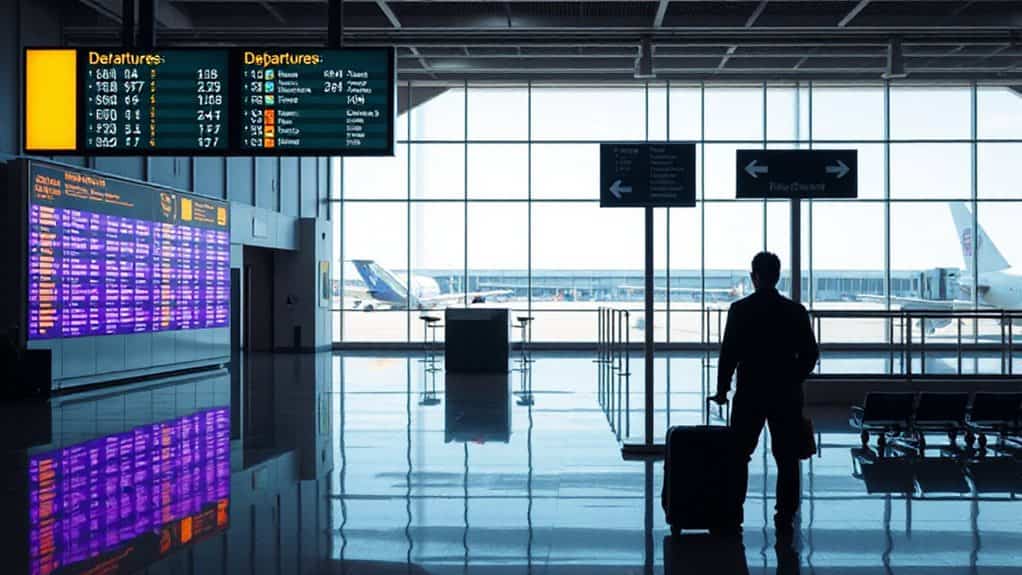
If a flight arrives early or is delayed, the airport must quickly reshuffle gate assignments to keep the overall schedule on track. You’ll see real‑time data from AODB, FIDS, and surveillance feeding a responsive gate reassignment structure. Integer programming or deep‑reinforcement models run in seconds, respecting RASAS limits, adjacency rules, and aircraft compatibility, while visual alerts flag conflicts instantly, maintaining runway flow and on‑time performance. Modern aircraft safety systems like TCAS traffic advisories show how layered, time-critical alerting can help prevent conflicts when conditions change rapidly.
PAX-DIST-Based Minimization of Passenger Walks in Gate Assignment
Real‑time gate reshuffling keeps the schedule intact, but it also creates an opportunity to cut passenger walking distances by assigning flights based on connection volumes. You use PAX-DIST to rank gates with departing passenger counts, placing high‑volume connections near each other. Binary integer models enforce one‑gate‑per‑flight, while heuristics like ADAP or evolutionary algorithms quickly generate feasible assignments, even with dummy gates for overloads. This reduces off‑gate events and shortens transfer walks, improving punctuality and traveler satisfaction. In the end, the same principle—minimizing bottlenecks—helps avoid the dreaded airport line delays.
Performance Metrics for Airport Gate Assignment Success
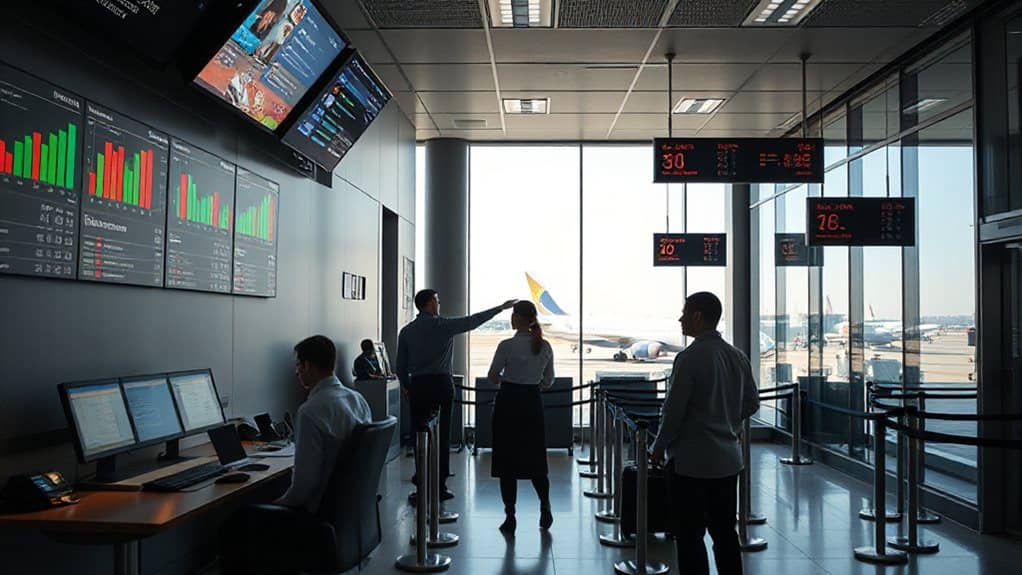
When you evaluate how well an airport’s gate‑assignment system is working, you look at a mix of operational, resilience, outcome, efficiency, and benchmarking metrics.
You track gate conflict frequency, re‑gating costs, taxi‑out delays, and buffer conformance.
Resilience shows through solution stability under delays and low standard deviation of conflicts.
Outcome metrics include average departure delay and connection protection.
Efficiency gauges turnaround and gate‑holding times, while benchmarking compares gates, operations, and real‑time reallocation speed.
Airports also weigh how thunderstorms can trigger cascading ground delays and require rapid gate reallocation to maintain safe, on‑time operations.
And Finally
In the end, gate assignments balance passenger convenience with airline efficiency. You’ll see that operational constraints, real‑time disruptions, and walk‑distance minimization all shape the final layout. Metrics such as gate utilization, turnaround time, and passenger travel distance quantify success. By integrating these factors, airports can assign gates that keep flights on schedule while reducing passenger hassle. The system remains flexible, adapting to changes without sacrificing overall performance.