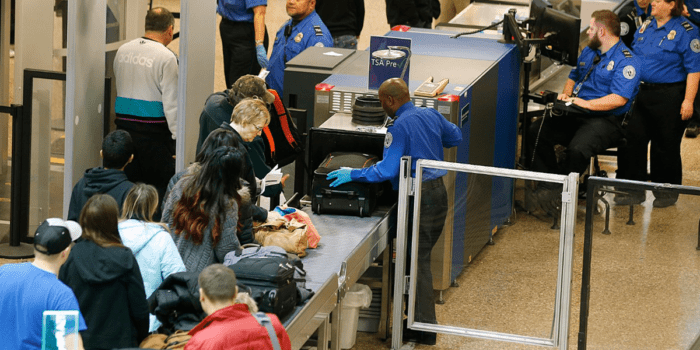
You can bring a hair dryer on a plane in both carry-on and checked baggage, as TSA classifies corded models as non-hazardous items. However, cordless hair dryers with lithium-ion batteries must comply with watt-hour limitations and go in carry-on only. You’ll need to remove your hair dryer from bags during security screening for separate X-ray examination. While TSA allows hair dryers, individual airlines may have specific wattage restrictions, so understanding the complete regulations guarantees smooth travel.
TSA Rules at a Glance
| Where | Allowed? | Key rule |
|---|---|---|
| Carry-on | Yes | Corded models are non-hazardous; cordless battery models up to 160 watt-hours with protected terminals |
| Checked luggage | Yes | Corded models can be checked; cordless with lithium-ion batteries travel in carry-on instead |
| Notes | Screening | Remove the hair dryer from your bag for separate X-ray exam; airlines may have their own wattage limits |
TLDR
- Corded hair dryers are allowed in both carry-on and checked baggage under TSA regulations.
- Cordless hair dryers with batteries must be packed in carry-on only and cannot exceed 160 watt-hours.
- Hair dryers must be removed from bags for separate X-ray screening at security checkpoints.
- Airlines may have individual wattage limits, so confirm specific policies before traveling.
- Battery terminals on cordless models should be protected with tape or original packaging during transport.
TSA Regulations for Corded and Battery-Powered Hair Dryers
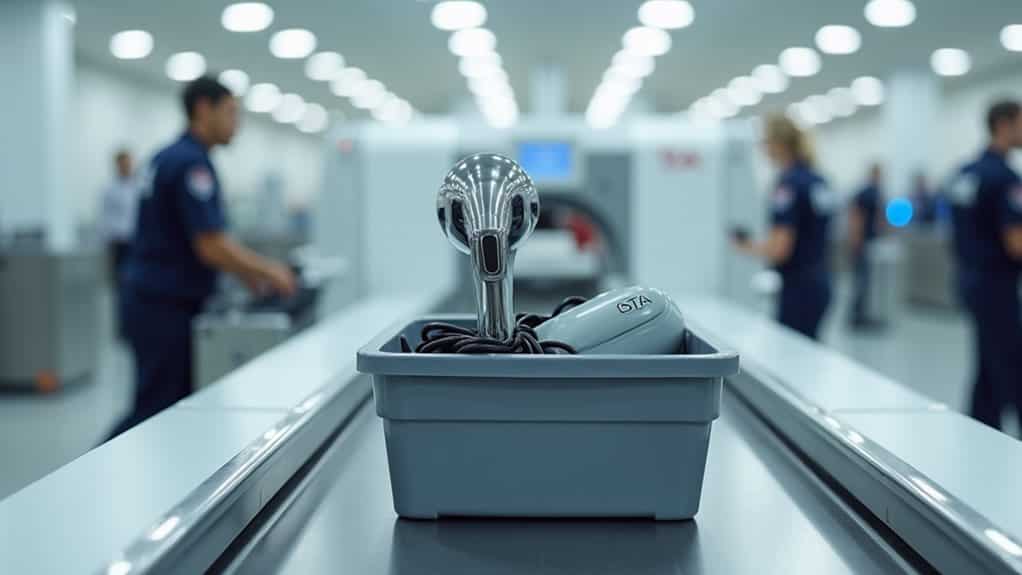
When you’re planning to travel with a hair dryer, understanding TSA regulations can save you time and prevent potential issues at security checkpoints.
Corded hair dryers are permitted in both carry-on and checked baggage without restrictions. These electric appliances are considered non-hazardous and typically pass through security screening without complications. Additionally, it’s important to note that airline-specific rules may vary, so confirming these details before your trip is essential.
However, battery-powered models face stricter rules based on lithium-ion battery capacity, requiring compliance with watt-hour limitations for safe transport.
Voltage by Region and What It Means for Your Dryer
Most travel hair dryers fail not at security but at the wall socket. Check the label on the handle before you pack: if it reads a single voltage such as 120V, it will not run correctly on a 230V supply, and a plug adapter will not fix that.
| Region | Voltage and frequency | Common plug type | What a US dryer needs |
|---|---|---|---|
| United States, Canada | 120V, 60Hz | A, B | Nothing, it is the native supply |
| United Kingdom, Ireland | 230V, 50Hz | G | Dual-voltage dryer plus a Type G adapter, or a converter rated above the dryer wattage |
| Most of Europe | 230V, 50Hz | C, E, F | Dual-voltage dryer plus adapter, or a converter |
| Australia, New Zealand | 230V, 50Hz | I | Dual-voltage dryer plus adapter, or a converter |
| Japan | 100V, 50Hz east / 60Hz west | A, B | Often works on a 120V dryer at reduced power; check the rating |
A dual-voltage dryer, usually marked 120-240V, switches itself and only needs a plug adapter. A single-voltage dryer needs a step-up or step-down converter, and converters are rated in watts: a 1,600W dryer needs a converter rated above 1,600W, which is heavier than the dryer. That is why most travellers buy a cheap dual-voltage dryer or use the hotel’s rather than carry a converter.
International Travel Considerations and Airline-Specific Policies
While TSA regulations provide a foundation for traveling with hair dryers domestically, international travel introduces additional challenges that require careful consideration. Different countries have varying electrical standards, requiring dual voltage hair dryers and universal adapters. Additionally, be mindful of the TSA’s 3-1-1 rule when packing your hair products to avoid any issues at security checkpoints. Airlines maintain individual policies regarding wattage limits and carry-on restrictions, so you’ll need to check specific airline requirements before departure. Travel-sized hair dryers are recommended for convenience when navigating these varying international regulations.
Battery Rules for Cordless Dryers
Cordless dryers run on lithium-ion cells, which are regulated separately from the appliance. The rules that apply on almost every airline, following ICAO and IATA guidance:
- Batteries rated up to 100Wh may travel in carry-on luggage. Most cordless dryer packs sit under this.
- Batteries between 100Wh and 160Wh need the airline’s approval before you fly, so ask at booking rather than at the gate.
- Spare or loose lithium batteries go in the cabin only, never in checked baggage, and each terminal must be protected against short circuit.
- A dryer with a non-removable battery is treated as a device, which usually means carry-on only once the pack is above the small-battery threshold.
If the pack is damaged, swollen or has been dropped hard, do not fly with it. Airlines refuse damaged batteries and security will remove them.
Battery Restrictions and Safety Requirements for Cordless Models
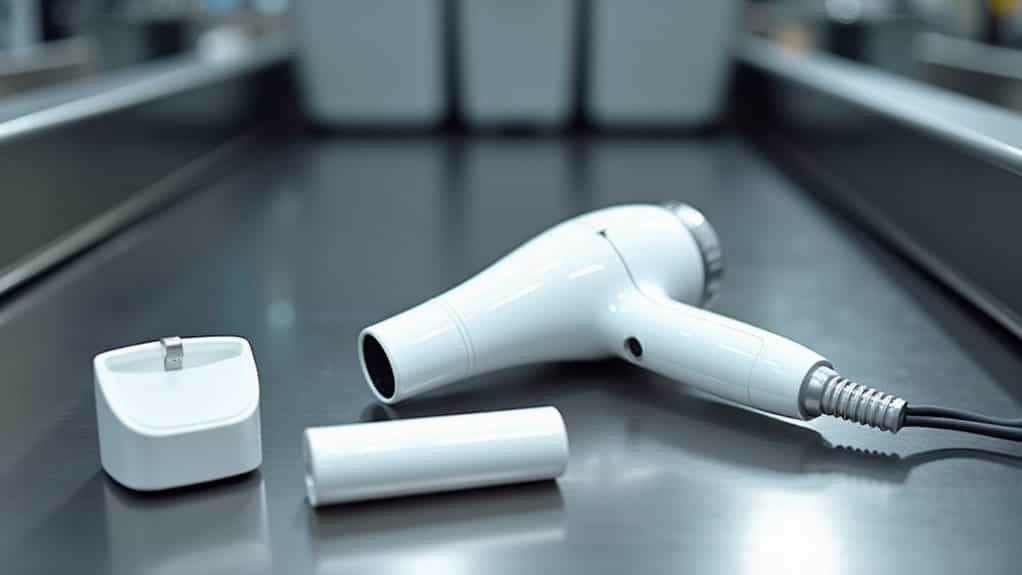
Most cordless hair dryers contain lithium-ion batteries that must comply with strict federal aviation regulations, making it essential to understand these restrictions before packing your device. Your cordless hairdryer’s battery can’t exceed 160 watt-hours, and you must pack it in carry-on baggage only. Protect battery terminals with tape or original packaging to prevent short circuits. Additionally, extra batteries for devices like electric razors must also be kept in carry-on bags to adhere to TSA guidelines. Hotels aside, clothes steamers follow the same corded-appliance test, set out in can you bring a steamer on a plane.
Carry-On Vs Checked Baggage: Best Packing Practices
Most airlines limit carry-ons to 22 x 14 x 9 inches with 15-22 pound weight restrictions. Bulky hairdryers often fit better in checked luggage, avoiding potential gate fees and TSA screening delays. Additionally, packing a clothing iron in checked baggage is preferred to avoid potential restrictions during security checks.
Security Checkpoint Procedures and Screening Guidelines
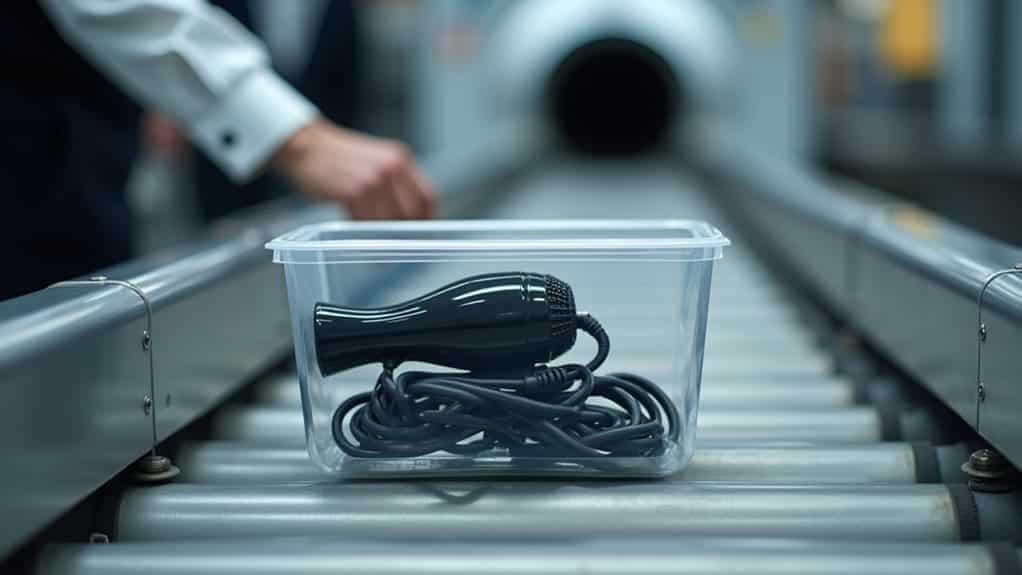
Once you’ve decided how to pack your hairdryer, you’ll need to maneuver through the TSA security checkpoint where specific procedures apply to all electronic devices.
Your hairdryer must be removed from your bag for separate X-ray screening, unless you have TSA PreCheck.
Agents will examine it alongside other electronics to make sure it doesn’t contain prohibited items.
Frequently Asked Questions
Can I bring a hair dryer in my carry-on?
Yes. TSA classifies corded models as non-hazardous, so they are allowed in carry-on, and cordless models with lithium-ion batteries are allowed as long as they stay within the watt-hour limits (up to 160 watt-hours) and the battery terminals are protected.
Can I pack a hair dryer in checked luggage?
Corded hair dryers can go in checked baggage. Cordless models with lithium-ion batteries should stay in your carry-on instead, following the standard battery rules.
Do I need to take my hair dryer out of my bag at security?
Yes, you will need to remove it from your bag for separate X-ray examination at the checkpoint. Your airline may also have its own wattage limits, so confirm them before you fly.
More Hair Dryer Questions
Can I use a US hair dryer in Europe? Only if it is dual-voltage (120-240V) and you have the right plug adapter. A single-voltage 120V dryer needs a converter rated above its wattage, which is impractical for most models.
Does the airline care about the battery in a cordless dryer? Yes. Lithium batteries up to 100Wh can go in carry-on, 100-160Wh needs airline approval, and spares go in the cabin only.
Will hotel hair dryers damage my hair? They are usually lower powered and run hotter, so they dry more slowly and expose hair to more heat over time. A compact dual-voltage dryer is the better option if that matters to you.
Is a hair dryer a prohibited item at TSA? No. Corded and battery-powered dryers are allowed in both carry-on and checked baggage; the limit is on the lithium battery, not the appliance.
And Finally
You can bring hair dryers on planes in both carry-on and checked luggage. Corded models face no restrictions, while battery-powered versions must meet lithium-ion safety requirements. You’ll need to remove hair dryers during security screening, so pack them accessibly. Check your airline’s specific policies and destination country regulations, as international rules may differ. Follow proper battery guidelines for cordless models, and you’ll have no issues traveling with your hair dryer.