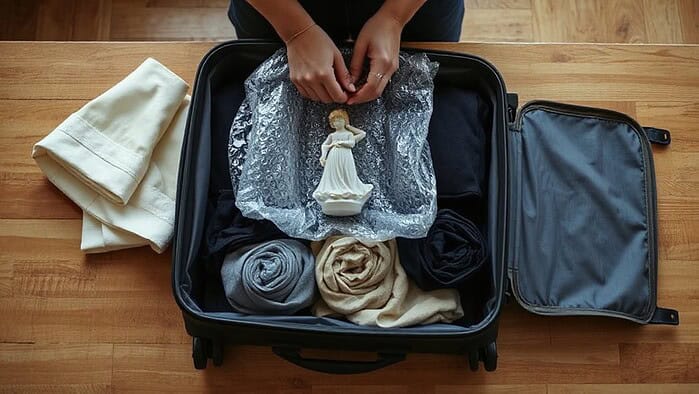
Pack your heaviest items—like shoes, jeans, and toiletries—at the bottom of your suitcase, centered near the wheels to keep the weight low and stable. Place them close to your back and aligned with your torso for better balance and easier rolling. Distribute dense items evenly side to side, and fill gaps with soft clothing to prevent shifting. Use packing cubes or compression bags to save space and keep weight concentrated. This method improves control and reduces strain—especially when maneuvering tight spaces or long distances. There’s more to optimizing your pack than just weight alone.
TLDR
- Place the heaviest items at the bottom of the suitcase, centered and close to the back to align with your spine.
- Balance weight evenly on both sides by distributing dense items like shoes or electronics symmetrically.
- Use packing cubes or compression bags to secure heavy items and prevent shifting during transit.
- Layer luggage from heavy at the base to light on top for better balance and easier access.
- Keep the center of gravity low by positioning weight above the wheels and avoiding top-heavy packing.
Start With the Heaviest Items at the Bottom

Start by placing the heaviest items at the bottom of your suitcase, right above the wheels.
Pack jeans, trousers, and shoes first along the edges for stability.
Put toiletry bags near the base too.
This keeps your center of gravity low, prevents tipping, and makes rolling easier.
Use packing cubes to group heavy items and save space.
This approach aligns well with the Folding and Stacking method, which emphasizes layering heavier garments like jeans at the base to maintain balance and reduce creasing.
Checked bags typically allow larger items and fewer liquid restrictions, so consider packing extras there when possible to avoid carry-on limits and excess baggage fees.
Align Weight With Your Torso for Comfort
Pack the heaviest items close to your back and centered in the suitcase to keep the load aligned with your spine.
Balance weight evenly from side to side so the bag doesn’t pull you off-center while walking.
This positioning helps maintain an upright torso and reduces strain on your core and lower back.
Use packing cubes and compression methods to organize and reduce bulk, which helps keep weight concentrated near your torso and prevents shifting during transit (packing cubes).
Pack Heavy Items Centrally
You’ll usually find it easier to maneuver your suitcase when heavy items are packed low and centered, aligned with your torso.
Place shoes, books, or electronics at the base, near the wheels, to prevent tipping.
This central positioning keeps weight balanced, reduces strain while pulling, and stops contents from shifting.
Even distribution across compartments enhances stability, especially in hard-shell cases, ensuring smooth, controlled movement through airports and tight spaces.
Balance Weight Side to Side
Often, the key to a smooth trek lies in how evenly you distribute weight from side to side. Place heavy items near the wheels and center them to prevent tipping.
Use packing cubes to balance both sides and fill gaps with soft items to stop shifting. Roll clothing and tuck into corners for stability. Test roll your suitcase to make certain even balance.
Align Load With Spine
Keeping your suitcase balanced side to side sets the foundation, but how you position the weight relative to your body matters just as much.
Align heavy items against your back, near your spine and low on your torso, to maintain your natural S-curve. This reduces strain, keeps you upright, and makes carrying easier. Keep loads close, centered, and supported with proper straps for comfort and control.
Distribute Weight Evenly Across Both Sides
When packing your suitcase, placing heavy items strategically guarantees the weight balances evenly across both sides, which improves stability and ease of movement.
Distribute shoes and dense objects equally, use packing cubes to organize, and fill voids with soft items.
This prevents tipping, secures smooth rolling, and keeps your load manageable—giving you freedom to move confidently through airports and streets without struggling or readjusting.
Measure your packed bag before travel to ensure it fits airline personal item size limits and avoid unexpected fees.
Use Soft Items as a Protective Base

Start by laying a foundation of soft items at the bottom of your suitcase to protect both your belongings and the bag itself.
Pack sweaters, jeans, or thick shirts flat to absorb impacts. Use compression bags to flatten bulky clothes and create a stable base.
Add thin cotton towels for moisture absorption.
Line the bottom with waterproof pouches or plastic bags wrapped in soft layers to guard against leaks and maximize protection.
Consider placing compression packing cubes or vacuum-seal bags over the soft base to further reduce volume and stabilize your load.
Position Heavy Bags at the Bottom of Stacks
Placing your heaviest items at the bottom of your suitcase isn’t just logical—it’s essential for stability. Pack jeans, jackets, and shoes low to create a solid base.
This keeps the center of gravity down, reducing tipping when moving or during rough handling. It also balances weight shifts and improves control on uneven surfaces, giving you freedom to move smoothly through travel chaos. Many travelers find that using luggage with reinforced wheel housings further improves stability and prevents wobbling when fully packed.
Layer Strategically From Heavy to Light

Start by placing your heaviest items, like shoes or toiletry bottles, at the bottom of your suitcase near the wheels for better balance.
Roll softer clothes like t-shirts and pants to fill the middle layer, which helps save space and reduces wrinkles.
Finish with lighter essentials like underwear or a sweater on top, so you can grab them easily without unpacking everything.
Choose a bag that stays within most airlines’ maximum checked size to avoid fees and fit more when packed under 62 inches.
Start With Heaviest Items
When packing your suitcase, building a stable foundation starts with the heaviest items at the bottom, where they’ll contribute to balance and prevent shifting during transit.
Place shoes first—they’re bulky and heavy, ideal for anchoring the base. Fill gaps with socks or soft items to secure them.
This bottom-heavy setup supports layers above and keeps weight evenly distributed, ensuring smoother travel.
Layer Lighter on Top
Now that your heaviest items are settled at the bottom, build upward by arranging lighter pieces on top to maintain balance and accessibility.
Layer clothing from light to heavy, using merino wool or quick-dry fabrics that resist odor.
Roll tops and pack them above denser items.
Use packing cubes or compression sacks for efficiency, and leave room for souvenirs.
Maximize Space Without Adding Bulk
Pack your suitcase like a pro by squeezing out every bit of wasted space without increasing bulk.
Roll clothes tightly to remove air, then tuck them into packing cubes.
Use compression bags for bulky items, and fill gaps with socks or chargers.
Layer flat pants first, stack cubes strategically, and compress as you go to save space efficiently.
Maintain Stability Near the Wheels

Always start by placing your heaviest items—like shoes, toiletry kits, or electronics—low in the suitcase, directly above the wheels.
Keep weight centered and balanced side-to-side to prevent tipping.
A lower center of gravity improves stability, especially on uneven surfaces.
Use suitcases with four recessed wheels for a wider, steadier base.
This setup rolls smoothly and stays upright, giving you effortless control as you move freely through terminals and streets.
Respect Airline Weight and Size Limits
While you might be tempted to maximize every inch of space, staying within airline size and weight limits saves you time, stress, and unexpected fees.
Airlines like Delta and JetBlue enforce strict carry-on dimensions—22 x 14 x 9 inches—and weight caps, especially on international flights.
Starting in 2026, expect sizers at gates and tablet checks.
Pack light, distribute weight evenly, and always measure your bag—including wheels and handles.
And Finally
You’ve packed smart by placing heavy items at the bottom and aligning weight with your torso. You distribute weight evenly, use soft items as cushioning, and stack heavier bags low for stability. You layer from heavy to light, maximize space without overloading, and keep weight near the wheels. You also respect airline size and weight limits to avoid fees. This balanced, thoughtful approach makes your suitcase easier to maneuver and less likely to exceed restrictions, ensuring smoother travel from start to finish.