You pay baggage fees based on how many bags you check, their weight, and size. Most airlines charge $30–$45 for the first checked bag domestically, but fees rise if your bag exceeds 50 lbs (23 kg) or 62 linear inches. Some carriers use weight-based or hybrid models, especially internationally, where costs can reach $200. Premium tickets or elite status often waive these fees. Packing light, using carry-ons, or choosing airlines with free bags helps avoid charges—there’s more to know about saving smartly.
TLDR
- Baggage fees are calculated per extra bag on piece-based systems, commonly charging $30–$45 domestically.
- Weight-based systems charge per excess kilogram, with standard limits around 50 lbs (23 kg).
- Hybrid models combine piece and weight rules, applying fees if either limit is exceeded.
- Oversized bags over 62 linear inches (158 cm) incur additional fees, sometimes up to $200 internationally.
- Fees vary by route, cabin class, and loyalty status, with premium travelers often receiving free allowances.
Understanding Baggage Calculation Types

Whether you’re booking a domestic flight or an international trip, understanding how airlines calculate baggage fees is essential to avoiding unexpected charges at the airport.
You’ll encounter piece-based systems, where fees apply per extra bag, weight-based models charging for excess kilograms, or hybrid rules combining both.
Each method varies by airline, route, and fare class, so always check your specific allowance to stay within limits and keep your travel costs under control. Additional fees may also apply for oversized baggage exceeding 158 cm in total dimensions, which is common on international routes and can significantly increase costs due to oversized baggage fees. Gate agents may also enforce size and weight limits at the gate, potentially requiring gate checking for bags that slightly exceed limits.
How Weight Limits Impact Your Fees
You’ve seen how airlines use different systems to calculate baggage fees, and now it’s time to look at one of the most common cost drivers: weight limits.
Most airlines cap standard bags at 50 lbs (23 kg), charging extra if you exceed it. Delta, American, and Spirit enforce this strictly. Premium cabins often allow 70 lbs (32 kg) for free.
Exceeding limits means fees—and heavier bags may require earlier check-in.
To avoid unexpected charges, measure and verify your carry-on and personal items against the airline’s size requirements before you travel.
The Role of Size and Dimension Restrictions

You need to watch your bag’s size, not just its weight, since most major airlines allow a maximum of 62 linear inches—length plus width plus height—including wheels and handles.
If your bag goes over that limit, you’ll pay extra, and on budget carriers like Spirit or Frontier, the fees can really add up fast.
To avoid surprises, measure your luggage fully extended and check the airline’s policy before you head to the airport.
Also consider choosing a soft-sided duffel when possible, since its flexibility can help you stay within size limits and avoid oversize fees.
Size Limits Matter
When packing for your trip, keep in mind that size limits for checked baggage play a crucial role in determining both acceptance and fees.
Most airlines cap bags at 62 linear inches, but Virgin Atlantic and Allegiant allow up to 80.
Exceeding limits triggers extra charges or rejection, especially over 80 inches.
Always measure your luggage to avoid surprises.
Dimension Rules Apply
While airlines may vary in their specifics, dimension rules for baggage are consistently enforced to guarantee safety, efficiency, and fairness across flights.
You’ll need to measure your carry-on (24” x 16” x 10” on Frontier) and personal item (14” x 18” x 8”) including wheels.
Checked bags are capped at 62 linear inches and 40–50 lbs, depending on the carrier.
Variations Across Domestic and International Flights
Though baggage fees often follow a standard structure, they vary markedly between domestic and international flights, depending on the airline, route, and destination region.
You’ll pay $30–$45 for your first checked bag domestically, but it’s often free to Europe or Africa.
International fees spike for extra bags—up to $200—while weight and size limits tighten, especially overseas.
Durability and design factors like spinner wheels and reinforced corners can affect luggage choice and potential replacement costs over time.
Influence of Passenger Status and Ticket Class
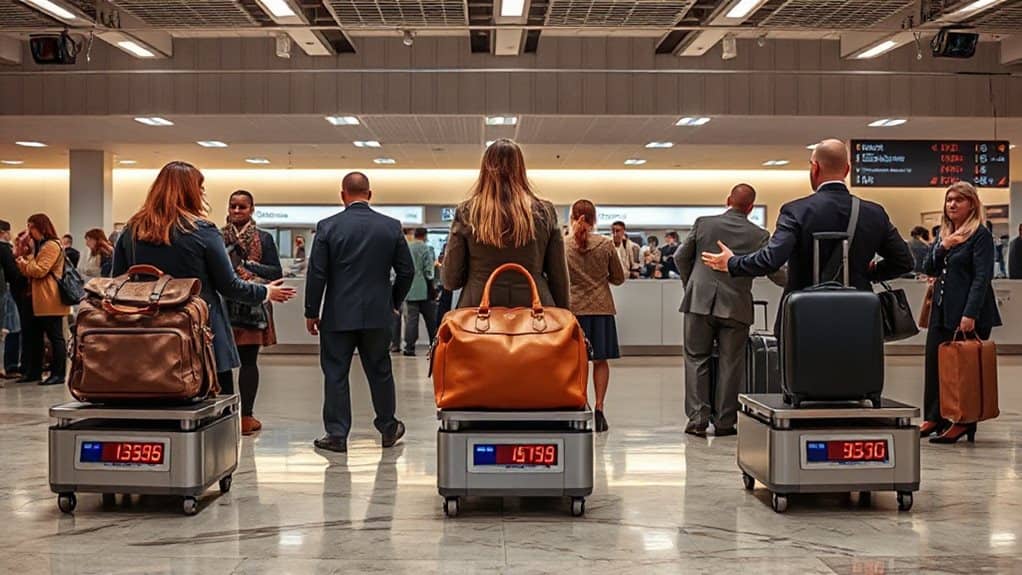
You’ll save on baggage fees if you hold elite status or fly in a premium cabin. Airlines waive fees for elite members and higher fare classes, often covering your first or even second checked bag.
Credit card perks and loyalty tiers can also cut costs, especially when flying economy.
Airlines’ waiver policies vary by carrier and fare class, so check your airline’s baggage policy for exact rules and exceptions.
Elite Status Perks
If you’ve earned elite status with a major airline, you’re likely entitled to beneficial baggage benefits that can save you money and streamline your travel.
Frontier Gold members get a free carry-on, while Delta Silver waives the first checked bag for up to eight companions.
American Gold grants two free checked bags, United Premier offers up to three, and Alaska, JetBlue, and Southwest provide free bags based on status—maximizing your travel freedom.
Cabin Class Benefits
Your ticket class plays a significant role in determining how much you can bring on board and in the hold, often shaping your travel experience as much as seat comfort or in-flight service.
Business Class lets you carry two 8 kg cabin bags, while Economy allows one, usually 7–8 kg.
Airlines like Ryanair limit carry-ons to 10 kg, whereas Air France and KLM permit up to 12 kg.
EasyJet doesn’t weigh if you can lift it.
Eurowings Smart includes a large carry-on.
Premium seats often expand allowances.
Loyalty Tier Advantages
Frequently, the number of bags you can check for free comes down to your loyalty status rather than your ticket class.
Higher tiers like Diamond or Executive Platinum grant two to three free checked bags, plus priority handling.
oneworld Emerald and Sapphire members get added allowances, with weight limits of 20 kg and 15 kg.
Credit card perks stack too—just book with your card and add your number to maximize benefits.
Special Services and Their Effect on Allowances

While your fare class plays a major role in determining baggage allowances, special services—particularly those for passengers with disabilities or reduced mobility—can markedly affect what you’re allowed to bring and how it’s counted.
You can bring assistive devices without them counting toward limits.
Manual wheelchairs get in-cabin priority if space allows.
Airlines provide free special assistance, including wheelchairs and support staff, when you request it 48–72 hours ahead.
Battery-powered wheelchairs are accepted if non-spillable and cargo-fit.
You’ll receive full compensation if your device is lost or damaged domestically.
Frequent flyer status might also expand your baggage privileges beyond standard fare rules.
Most hotels and airlines coordinate to assist late arrivals and special-needs travelers when notified in advance, including ensuring staff availability during overnight hours and 24-hour service for smooth transitions.
Strategies to Minimize or Avoid Baggage Charges
Getting a handle on baggage fees starts with understanding how airlines calculate them, since rules vary widely depending on the carrier and route.
You can avoid charges by packing light and using carry-ons, especially with full-service airlines that allow them free. Choose airlines offering free checked bags, or ship luggage via courier for long trips—it’s often cheaper and more flexible.
And Finally
You now understand how airlines calculate baggage fees based on weight, size, and route. Domestic and international flights often have different rules, and your ticket class or frequent flyer status can affect allowances. Special services may change what you can bring free. To avoid extra charges, always check your airline’s policy before you fly. Packing smart and measuring your bags helps you stay within limits and saves money in the long run.