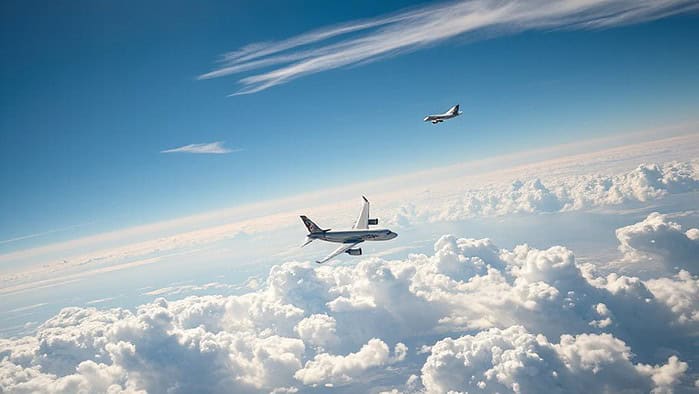
You feel turbulence as bumps during a flight, but it’s actually chaotic fluid motion driven by instabilities and energy cascades. Tiny disturbances grow into unpredictable swirls and eddies due to vortex stretching and shear. It thrives on high Reynolds numbers, where inertia overwhelms viscosity. This chaos enhances mixing, spreads energy across scales, and appears in rivers, storms, and engines—shaping how systems behave in nature and design. There’s more to how these forces unfold than meets the eye.
TLDR
- Turbulence is chaotic fluid motion characterized by unpredictable eddies and rapid mixing of momentum, heat, and mass.
- It arises when inertial forces dominate viscosity, typically at high Reynolds numbers in three-dimensional flows.
- Energy cascades from large to small vortices, sustaining turbulence through vortex stretching and shear instabilities.
- Small changes in flow conditions can trigger turbulence, making it sensitive and difficult to predict over time.
- Turbulence impacts nature and engineering—from storm dynamics to aircraft safety and pipeline efficiency.
The Chaotic Nature of Fluid Motion

While you might think fluid motion follows predictable patterns, even the smallest changes in initial conditions can trigger wildly different outcomes—a hallmark of chaos known as the butterfly effect.
You see this in rivers, where tiny shifts spark complex flow changes.
Chaos is precisely defined, unlike turbulence, and measured by the Lyapunov exponent.
It disrupts predictability, especially in natural fluid systems.
These systems exhibit predictability time horizons ranging from 3.4 to 9.3 months based on Lyapunov time calculations.
Key Characteristics That Define Turbulence
You’ll notice turbulent flows are never smooth—they’re full of chaotic, unpredictable eddies and fluctuations that make exact predictions impossible.
These irregular motions enhance mixing, rapidly spreading momentum, heat, and mass through the fluid. At the same time, swirling vortices form and stretch, transferring energy across scales while sustaining the turbulence.
Chaotic Flow Patterns
When you look at a turbulent fluid in motion, its chaotic nature becomes immediately apparent—velocity and pressure shift unpredictably, creating a flow full of swirling eddies and irregular fluctuations.
You’ll notice these patterns aren’t random noise; they’re structured chaos, driven by vortex stretching and energy cascades.
Though sensitive to initial conditions, true turbulence requires diffusivity, three-dimensionality, and high Reynolds numbers to sustain its lively, ever-changing behavior.
Enhanced Mixing Effects
Because turbulence dramatically increases the rate at which fluids blend, it plays a central role in defining efficient mixing processes across engineering and environmental systems.
You’ll see enhanced mixing when anisotropic strains or jet actuation introduce larger, distorted structures.
These changes improve mixing efficiency, especially under light winds or in controlled flows, where turbulence characteristics directly influence heat transfer and fluid interaction, making precise model adjustments essential for accurate predictions.
Vortex Formation Dynamics
Vortices form when fluid motion becomes unstable, and small disturbances grow into rotating structures that shape the heart of turbulent flow.
You’ll see them emerge from boundary layer separation, shear instabilities, or density gradients. Kelvin-Helmholtz rolls up shear layers, while centrifugal forces spawn vortices over wavy walls.
These rotating cores stretch, merge, and intensify, driving turbulence through cascading energy and persistent vorticity.
What Triggers Turbulent Flow
Although smooth and orderly at low speeds, water flow doesn’t stay that way forever—small changes in conditions can quickly push it into chaos. You’ll see turbulence when velocity increases, overcoming viscosity’s stabilizing effect.
Obstacles, sharp corners, or inlet disturbances create eddies. Pumping or temperature shifts add energy, disrupting laminar flow. Inertial forces dominate, mixing layers, triggering chaotic motion as energy cascades down to smaller scales. The visible distance of storm tops can reach hundreds of miles in clear conditions, meaning cumulonimbus tops can sometimes be observed from very far away.
The Role of the Reynolds Number

The Reynolds number gives you a clear way to predict when fluid flow will turn turbulent. You calculate it using density, velocity, length, and viscosity.
Low values mean smooth, laminar flow; high ones signal turbulence. It helps you scale models, design systems, and interpret natural flows—from blood in arteries to clouds in the sky—giving you control over real-world fluid behavior. Heavy aircraft generate strong wake turbulence that illustrates how large-scale flows produce powerful vortices.
Real-World Examples of Turbulence
You’ve likely felt turbulence during a flight, when sudden bumps or drops occur without warning.
It happens naturally, like when your plane crosses over mountains or storms, or from air disturbances near other aircraft.
These real-world conditions test pilots and planes, showing why understanding airflow matters in aviation.
Modern Doppler radar helps pilots detect and avoid hazardous storm cells in real time, improving safety around severe thunderstorms.
Nature’s Turbulent Displays
When you feel a sudden gust of wind tug at your coat or watch leaves spiral unpredictably down a river, you’re seeing turbulence in action—nature’s way of turning smooth flows into chaotic, swirling motion.
Breaking waves mix air and water violently, while campfire flames flicker due to turbulent combustion.
Even small disturbances, like a twig in a stream, spawn eddies downstream, revealing how easily order shifts into disorder.
Engineering Flow Challenges
Nature doesn’t just show turbulence in swirling leaves or crashing waves—it throws it at engineers every day in the form of real-world design challenges.
You deal with it in pipes, where turbulence increases resistance and cuts efficiency. On wings, it amplifies drag and risks separation. Simulations struggle to capture its scale, demanding massive computing power. You need accurate models to predict flow, save energy, and keep designs flying or flowing smoothly under pressure.
Effects and Consequences in Nature and Engineering

Although turbulence arises from seemingly ordinary fluid motions, its effects ripple across both natural systems and engineered environments in deep ways.
You experience it in flight delays and seatbelt signs, while weather models struggle to predict its randomness. It spreads pollutants, shapes ocean currents, and challenges engineers with unpredictable stress peaks and dissipation rates, all driven by tiny triggers that amplify into large-scale, chaotic consequences. Recent safety initiatives have reduced accident rates significantly in aviation, illustrating how targeted measures can mitigate risks from unpredictable forces like turbulence reduced accident rates.
And Finally
You now understand that turbulence is chaotic fluid motion marked by irregular, swirling flows. It arises when inertia overcomes viscosity, often predicted by the Reynolds number. You see it in rivers, storms, and aircraft travel. In engineering, turbulence affects efficiency and design. Recognizing its causes and effects helps you manage its impact across systems, from pipelines to weather forecasting. It’s complex, but key principles make it predictable and controllable in practice.