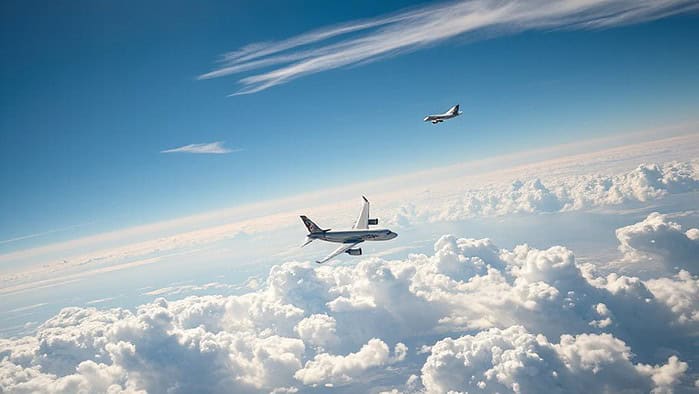
You hear loud noises during landing because your plane’s flaps, landing gear, and airflow disruptions create intense sound as it slows down. Extended flaps and slats generate turbulence and vortices, while the landing gear produces a deep rumble from swirling air and vibrating cavities. Even though engines are still running, most noise comes from the airframe, not the engines. Sound fades with distance due to spreading and atmospheric effects—there’s more to how each part adds to the roar.
TLDR
- Extended flaps and slats disrupt airflow, creating turbulence and tonal noise during landing approach.
- Landing gear generates a broad-spectrum rumble due to turbulent airflow around wheels and struts.
- Engine noise, though reduced during landing, includes buzzsaw roar from supersonic fan blades.
- Vortices from flap edges and gear components produce swirling air sounds and high-frequency tones.
- Noise decreases with distance, dropping about 6 dB each time the distance from the plane doubles.
What Causes the Loud Noises During Landing?
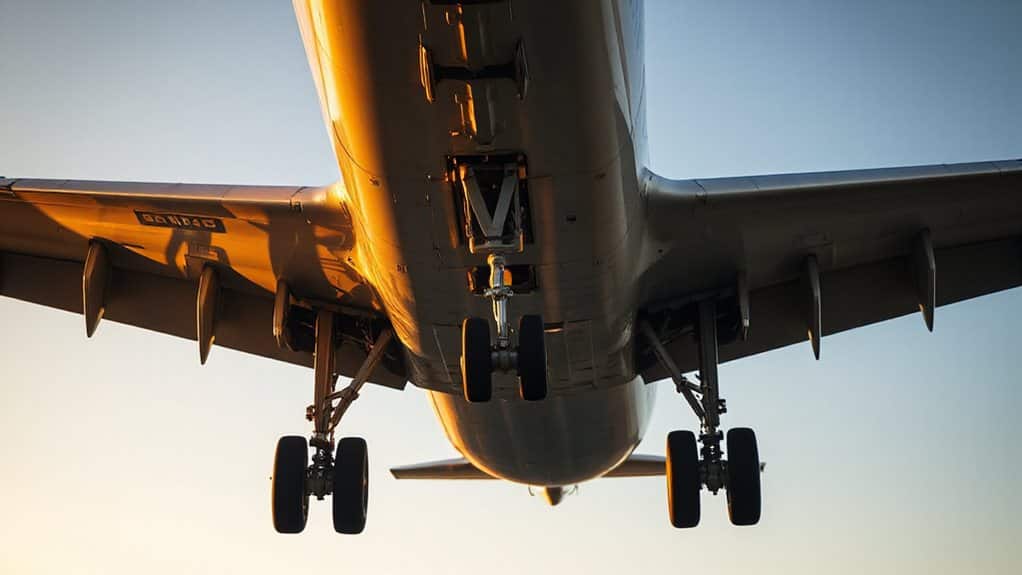
As you descend toward the runway, the aircraft comes alive with an orchestra of sounds, many of which stem directly from the engines.
You’ll hear a buzzsaw roar as fan blades go supersonic, and a high-pitched whistle from spinning turbines.
Exhaust mixing with air creates loud pressure waves, while increased engine power near the ground amplifies the noise you experience.
However, much of the noise during landing actually comes from the airframe, particularly the extended landing gear and flaps.
Helicopters and other aviation operations often follow specific altitude and operational procedures that can affect perceived noise levels near the ground, especially during low-altitude activities.
How Do Wings and Flaps Create Landing Noise?
When the plane begins to descend, you’ll notice a shift in the outside noise—not just from the engines, but from the wings themselves.
As flaps extend, they change the wing’s shape, increasing lift but also creating turbulence and vortex shedding.
Gaps between slats and flaps amplify airflow interactions, generating tonal and broadband noise.
Separated flows at hinges and coves produce unsteady vortices, while flap tips swirl with vortex noise—each component adding to the distinct sound of landing.
Optimal landing performance also depends on managing fuel capacity and aircraft weight to maintain safe approach speeds and configurations.
How Does Landing Gear Generate Landing Noise?
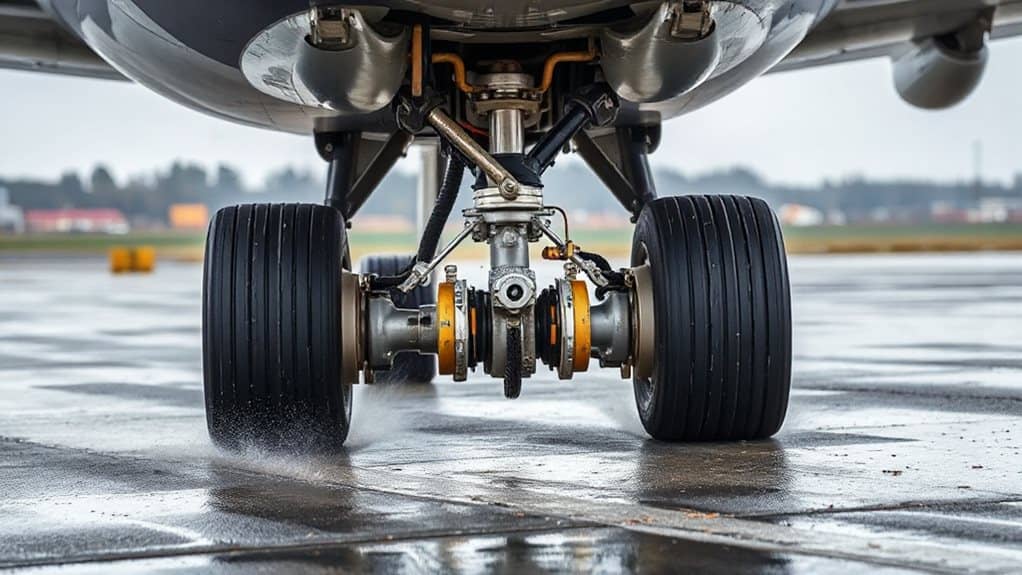
You hear a loud rumble as the landing gear drops into place, and that’s no accident—this complex system becomes a major source of noise during approach.
Turbulent airflow around wheels, struts, and hinges generates broad-spectrum sound, especially up to 10 kHz.
Cylindrical parts shed vortices, creating tonal hums, while cavities reverberate loudly.
Small features amplify high frequencies, and installation effects like reflections increase noise further, making landing gear a dominant contributor.
Large commercial airliners with multiple wheel assemblies often produce more landing-gear noise due to the higher number of contact points and structural elements like multiple wheels.
Is Engine or Airframe Noise Louder During Landing?
The rumble you hear as the plane descends isn’t just from the engines—it’s largely due to the airframe itself.
During landing, airframe noise dominates, especially from landing gear, flaps, and slats disrupting airflow.
While engines still contribute, their noise is lower than during takeoff.
You’re hearing vortices and turbulence from extended components, making the airframe the louder source as the plane touches down.
This effect is similar to how turbulence and vortices around aircraft components produce most of the noise during approach.
Why Does Landing Noise Change With Distance?
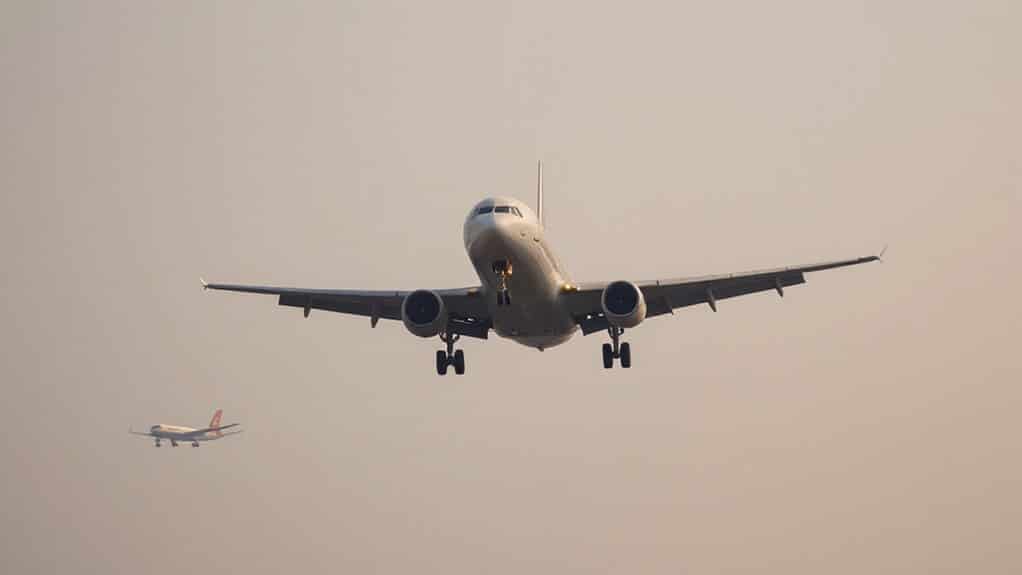
Although you might notice the roar of a landing plane fading as it moves farther away, that change isn’t just perception—it follows precise physical patterns.
Sound drops 6 decibels each time the distance doubles, and atmospheric absorption adds 1–2 decibels per 1,000 feet.
Together, they reduce noise steadily, with less impact at greater distances, eventually fading to near silence beyond 10,000 feet.
Pilots also use Doppler weather radar to navigate around weather that can affect perceived noise and flight paths.
And Finally
You hear loud noises during landing because of air rushing over extended flaps and landing gear. As the plane slows, these parts disrupt airflow, creating turbulence and sound. The engines also idle lower, making airframe noise more noticeable. Distance affects what you hear—closer, it’s sharper and louder; farther, it’s muffled. Each factor combines to produce the familiar landing sounds you experience from the ground or your seat.