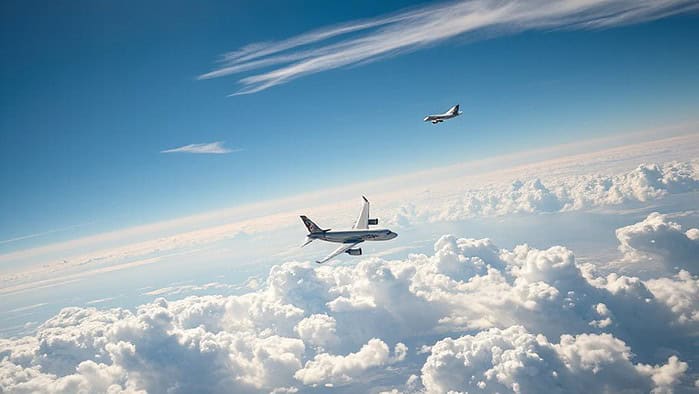
You avoid midair collisions by combining sharp visual scanning with advanced technology and air traffic control guidance. You keep your eyes outside the cockpit, especially in clear conditions, while relying on systems like TCAS to monitor nearby traffic. If a threat arises, TCAS issues alerts and tells you exactly how to respond—climbing or descending to safety. You follow these commands immediately, even if they conflict with ATC instructions. Modern airspace design and future upgrades like ACAS X further enhance safety, showing how layered defenses work together to protect every flight.
TLDR
- Pilots maintain constant visual scanning to spot and avoid nearby aircraft, especially in visual conditions.
- TCAS issues traffic and resolution advisories to guide pilots in avoiding potential collisions.
- Air traffic control provides separation through radar, clearances, and coordinated routing.
- Transponders and ADS-B enable aircraft to share position and altitude for better situational awareness.
- Standardized airspace design and flight procedures reduce conflict risks during takeoff, en route, and landing.
How Do Planes Avoid Midair Collisions?
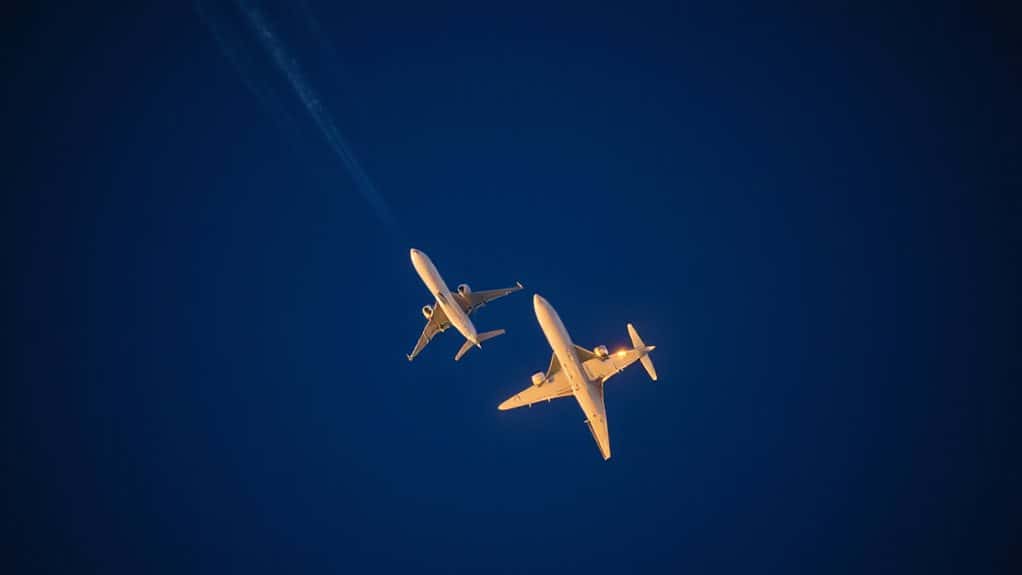
You’re always responsible for keeping your aircraft clear of others, and that starts with consistent visual scanning.
Watch for aircraft that grow larger but don’t move—they’re on a collision course.
Use guidance lights, landing lights, and anti-collision systems to stay visible.
Monitor CTAF, announce your position, and keep your transponder on.
Even with radar and ADS-B, stay alert—your eyes are your best defense.
Remember that larger “heavy” aircraft generate strong wake turbulence that can persist and affect following aircraft, so always give them extra separation wake turbulence.
How Does TCAS Help Pilots Avoid Midair Crashes?
While your eyes remain a primary tool for spotting nearby aircraft, technology like the Traffic Collision Avoidance System (TCAS) adds a critical layer of protection.
TCAS calculates collision risks using radar and transponder signals, then issues traffic or resolution advisories.
You’ll get clear climb or descent commands if needed, even overriding ATC instructions.
It works automatically with nearby planes, ensuring coordinated maneuvers and giving you more freedom and safety in the skies.
This system is particularly effective because it operates independently of ground-based air traffic control, relying instead on direct aircraft-to-aircraft communication.
Short-haul operations tend to increase pressurization cycles and thus the number of takeoffs and landings that affect aircraft stress.
What Triggers a TCAS Traffic Advisory (TA)?
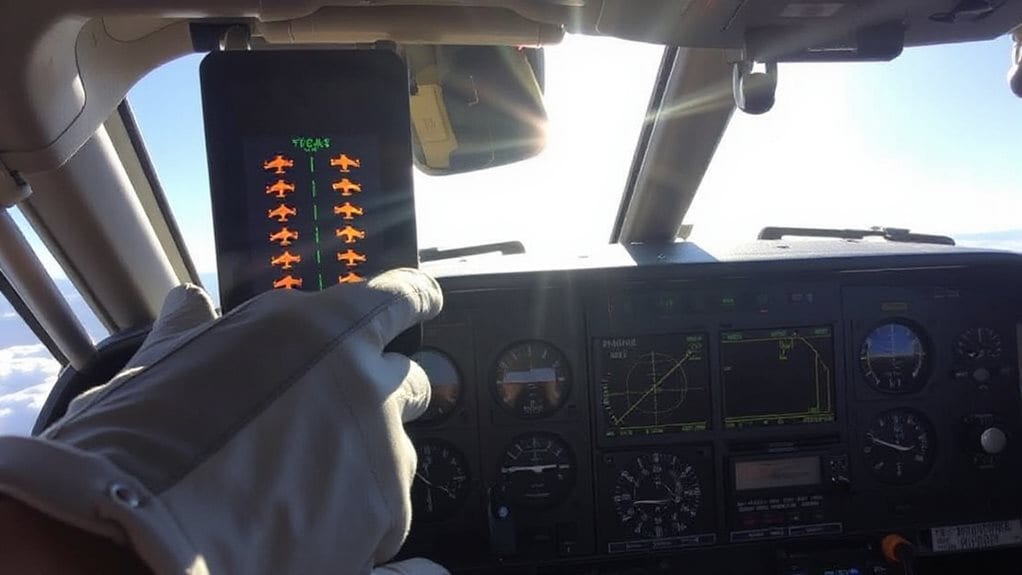
What causes a TCAS Traffic Advisory to sound in the cockpit? It triggers when another aircraft gets too close, typically 20–48 seconds before the closest point of approach.
Your system detects range, bearing, and altitude, then issues “Traffic, traffic” with a yellow symbol on your display. You’ll see vertical speed and position data, helping you spot the intruder visually while staying ready for possible further action.
When Does TCAS Issue a Resolution Advisory (RA)?
A Traffic Advisory alerts you to nearby aircraft, but when the situation gets more urgent, the system takes stronger action.
TCAS issues a Resolution Advisory (RA) when collision risks grow, typically below 35 seconds to impact at high altitudes.
You’ll get corrective RAs to change vertical speed or preventive ones to maintain it.
RAs coordinate between aircraft, ensuring opposite maneuvers—like climb and descent—for safer separation, and they override ATC instructions.
How Should Pilots Respond to TCAS Alerts?
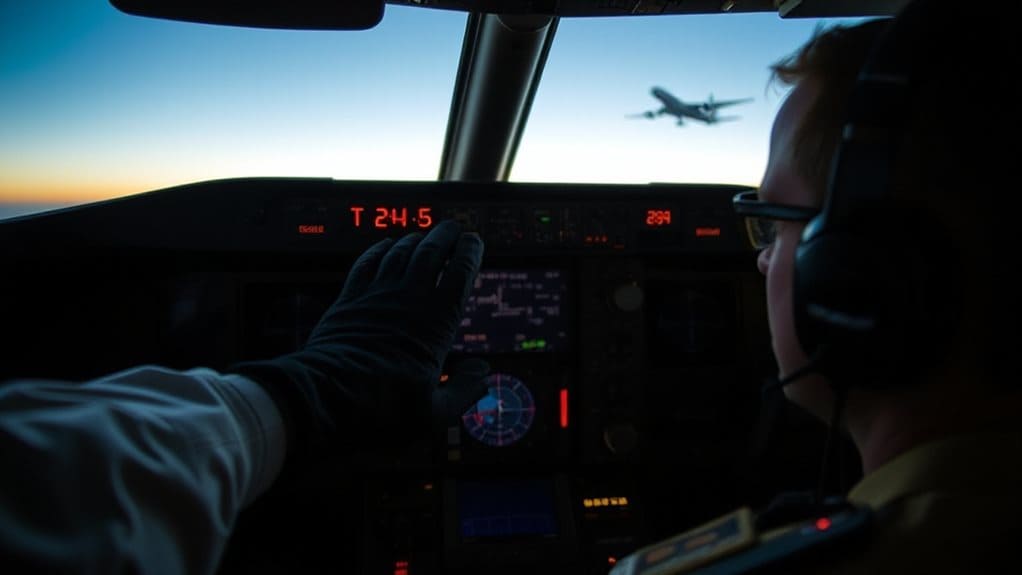
If you get a Traffic Advisory (TA), stay alert and look for the conflicting aircraft, but don’t maneuver yet—just monitor the situation.
The moment a Resolution Advisory (RA) sounds, disconnect the autopilot and hand-fly the plane to follow the command without delay.
You’ll have just seconds to respond, so act quickly and precisely to guarantee safe separation.
Thunderstorms and other severe weather can increase the risk of in-flight encounters and require extra vigilance from pilots when responding to traffic alerts, so coordinate with ATC and be aware of gust fronts around airports.
Traffic Advisory Response
When you receive a Traffic Advisory (TA) from the TCAS, the system alerts you with an audible “Traffic, traffic” callout and displays the intruder aircraft as a yellow or solid amber circle on your guidance screen. You’ll see its bearing, relative altitude, and vertical trend.
Immediately scan visually for the traffic while keeping one pilot on instruments. Don’t maneuver—maintain your cleared path. Use the display to help spot the aircraft, stay aware, and prepare in case a Resolution Advisory follows. Notify ATC only if they initiate avoiding action.
Resolution Advisory Actions
Follow the TCAS Resolution Advisory without hesitation—your immediate response guarantees safety. Smoothly climb or descend as directed, ignoring conflicting ATC commands. Never do the opposite. Limit maneuvers to what’s needed. If the RA reverses, comply promptly. After “Clear of Conflict,” return to your clearance. Tell ATC about the deviation when you can, using “TCAS RA.”
Why Might TCAS and ATC Give Conflicting Instructions?
While both TCAS and ATC are designed to keep aircraft safely separated, conflicts between their instructions can arise due to differences in timing, awareness, and coordination.
You might get a TCAS Resolution Advisory faster than ATC detects the threat. Controllers can’t see your TCAS data, so their instructions may clash with automated maneuvers. Radio congestion or delayed pilot reports can worsen the mismatch, risking conflicting climb or descent orders. Modern systems like onboard Doppler weather radar also highlight hazards that may not be immediately apparent to controllers, improving situational awareness for pilots by detecting thunderstorm cells in real time.
When Can TCAS Fail to Prevent a Collision?

You might think TCAS always prevents collisions, but it can fail if an aircraft’s transponder isn’t working or is turned off, making the plane invisible to the system.
Even with a functioning transponder, if you don’t follow your Resolution Advisory, the system’s protection breaks down, especially if the other pilot does the same.
In busy airspace, where RAs happen more often, high traffic density and conflicting ATC instructions can further reduce TCAS effectiveness.
This risk underscores the importance of coordination and vigilance among pilots and controllers.
Transponder Dependency Issues
TCAS can’t see every aircraft in the sky, and its effectiveness depends heavily on functioning transponders.
If your transponder’s off or fails, TCAS treats you as invisible.
Older models don’t report altitude accurately, and without Mode S, coordinated maneuvers won’t work.
Inaccurate data skews collision predictions, especially in busy airspace where system overload increases risks.
Pilot Noncompliance With RAs
Even with a working transponder, TCAS can’t guarantee safety if pilots don’t follow its instructions.
You might descend when ATC says so, but if the other plane climbs per RA, risk increases.
Misinterpreting “Adjust” commands or ignoring RAs—like in Überlingen—leads to collisions.
Higher RA rates in GA, delayed responses, and noncompliance defeat TCAS logic, making adherence critical.
High-Density Airspace Challenges
Often, even in well-monitored airspace, TCAS can struggle to prevent collisions when operating in high-density environments. You’re relying on a system designed for 0.3 aircraft per square nautical mile, but denser traffic overloads transponder interrogations.
When utilization exceeds 2%, tracking degrades. Surveillance range drops to 14 nautical miles, and performance falters—putting safety at risk despite automation.
What’s Next for Airborne Collision Avoidance Tech?
As aviation technology advances, you can expect airborne collision avoidance systems to become smarter and more integrated with modern airspace operations.
You’ll see ACAS X replacing TCAS II, using adaptive programming and ADS-B for optimized, cost-effective maneuvers.
ACAS Xu enables drones to safely share airspace, meeting “see and avoid” rules.
With global standards like DO-365 and ICAO updates, you gain seamless, future-ready flight freedom.
Exit row seating trade-offs such as extra legroom and limited recline are examples of safety taking precedence over comfort.
And Finally
You rely on TCAS and air traffic control to keep flights safe, but you must stay alert. TCAS warns you of nearby planes and tells you to climb or descend if needed. You follow resolution advisories immediately, even if they clash with ATC instructions. While TCAS is effective, it can fail due to equipment or visibility issues. New tech will keep improving airborne safety, reducing collision risks further in the years ahead.